Dev log
AI Is Not One Thing: Why the Future Belongs to People Who Understand Where It Fails
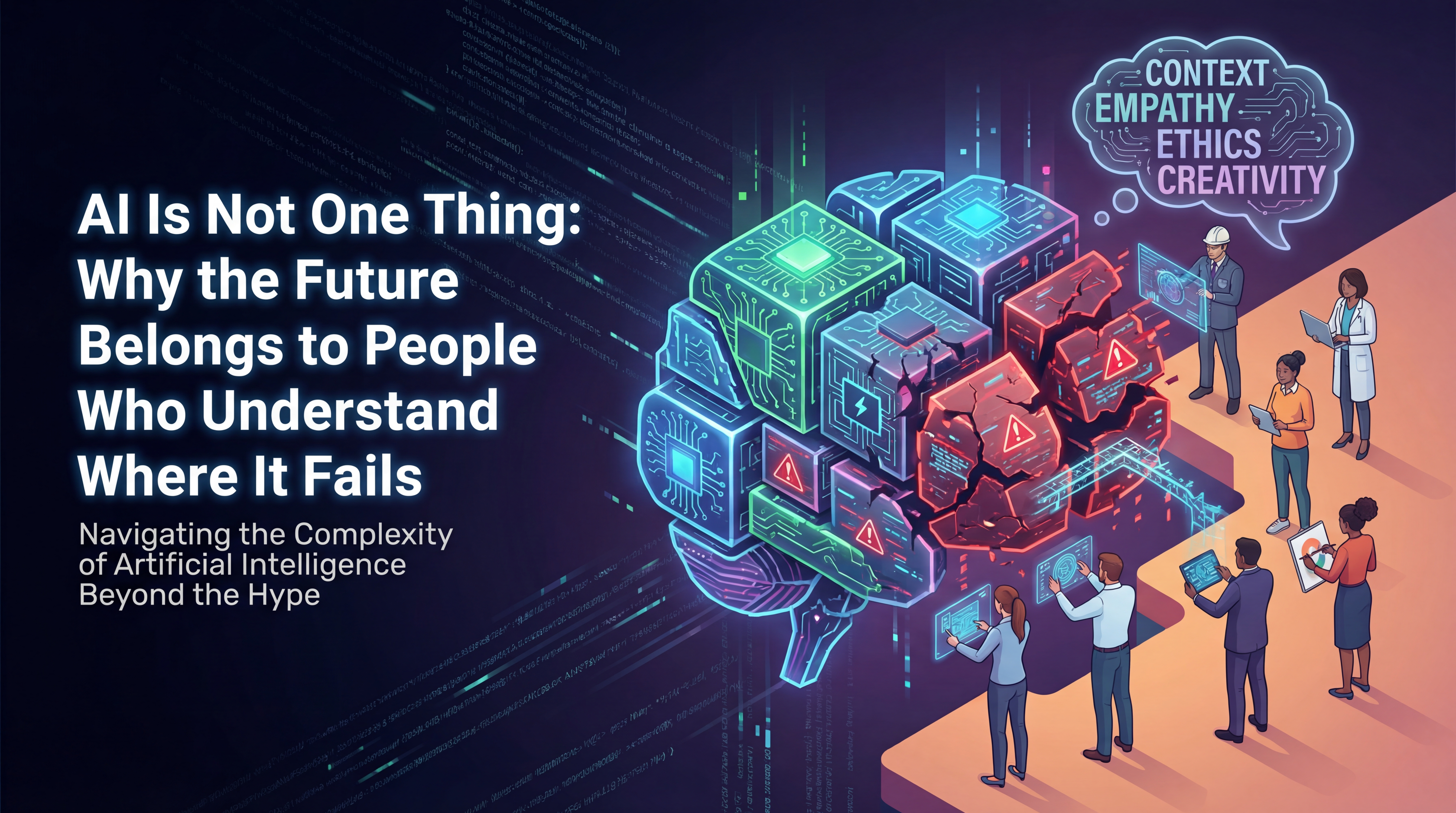
A lot of arguments about AI sound smart for about ten seconds.
Then you actually think about them.
One of the most common goes like this: AI can help with small things, maybe even medium things, but once the work gets complicated, once the code gets long, once the system becomes serious, humans will always take back over because AI makes too many mistakes. The implication is comforting: AI may be useful, but it will remain limited enough that the existing world of work mostly stays intact. Maybe developers get a better autocomplete tool. Maybe writers get a faster draft machine. Maybe customer service gets some chat support. But the real jobs, the real thinking, the real production? That will still belong to people.
That argument sounds reasonable until you push on it.
Yes, AI makes mistakes. Yes, it hallucinates. Yes, it can produce broken code, shallow reasoning, or confident nonsense. But that fact alone does not protect the current structure of work. Human beings make mistakes too. Junior developers make mistakes. Mid-level developers make mistakes. Senior developers make mistakes. Teams make mistakes. Entire companies build brittle systems, write bad documentation, create sprawling technical debt, and ship bugs for years. Human error has never prevented automation. In most cases, automation wins as soon as it becomes good enough, cheap enough, fast enough, and easy enough to supervise.
That is the real point people miss. The threshold is not perfection. It never was.
The washing machine did not need to wash clothes with artistic genius. The calculator did not need to understand mathematics like a professor. GPS did not need the instincts of a veteran taxi driver. Each of those technologies only needed to make the average user dramatically more capable while reducing the amount of labor required. Once that happened, the structure of the work changed.
AI is heading down that same road, but people still talk about it as if it were one simple thing. It is not. AI is not one tool. It is not one product. It is not one job category. It is not even one layer of the stack. AI is a capability that can be inserted into many different phases of human activity, at many different levels of abstraction, with many different effects.
That distinction matters because it changes the whole conversation.
##The lazy way people talk about AI
When people say “AI,” they often collapse a huge range of realities into a single vague blob. They treat it as though it is just one kind of software doing one kind of task. That leads to bad conclusions.
AI can teach you something you never understood before. It can explain a concept in plain language. It can generate examples. It can quiz you. It can adapt explanations based on how you respond. In that role, it is a tutor.
AI can help you build something you have never built before. It can draft code, outline a business plan, structure a workflow, suggest architecture, summarize documentation, or turn rough ideas into a starting point. In that role, it is an assistant.
AI can speed up work you already know how to do. It can automate repetitive tasks, create first drafts, transform data, classify information, or help you move faster through the boring parts. In that role, it is an accelerator.
AI can sometimes produce a finished output for you with very little effort from your side. It can generate a logo, a script, an image, a landing page, an email sequence, a prototype, or a chunk of working code. In that role, it is a generator.
And in some cases, AI can operate more like an agent—taking in a goal, making sub-decisions, using tools, executing steps, and returning results with minimal supervision.
Those are not the same thing.
If you do not separate them, your thinking stays muddy. You end up arguing against a cartoon version of AI instead of the real thing.
Using AI is not the same as understanding AI
There is also a major difference between using AI and understanding AI.
A person can use AI casually and get value immediately. That part is easy. Ask a question, get an answer. Request some code, get a draft. Upload a spreadsheet, get a summary. Anyone can do that.
But real understanding comes later.
Real understanding means building intuition about where AI tends to break. It means learning what kinds of tasks it handles well, what kinds of errors it makes, and how those errors show up. It means noticing when the output feels polished but is structurally wrong. It means realizing that some models are fast but shallow, some are smarter but slower, some are cheap but messy, and some are expensive because they are actually worth it for the right task.
That intuition does not come from standing on the sidelines and making blanket statements about AI. It comes from using it repeatedly across many contexts.
You need to see where it falls apart.
You need to compare different models.
You need to watch how it behaves when the task is fuzzy versus precise, when the context is short versus long, when the data is clean versus messy, when the problem requires logic versus language versus pattern recognition versus judgment.
That is where AI literacy really begins.
It is not just “knowing prompts.” It is not “getting decent outputs.” It is judgment. It is system design. It is knowing when to trust, when to verify, when to constrain, and when to keep AI out of the loop entirely.
That is why the people who win in the next phase will not just be people who use AI. They will be people who understand where it fails and build around those failure modes.
AI is not one tool. It is a smart component you can place in different parts of a machine.
Here is a simple way to make this visible for the average person: think of AI like a smart component you can install in different parts of a physical machine.
Take a car factory.
A car factory is not one action. It is a layered system. First there is planning: what kind of car are we even trying to build? Then design: how should the parts be shaped and arranged? Then sourcing: where do materials come from? Then assembly: how is the car physically put together? Then inspection: are there defects? Then distribution: how does it reach the customer? Then operation: how does the car behave on the road? Then maintenance: how do you diagnose and repair problems later?
Now imagine adding AI to different layers of that system.
Put AI in the planning room and it changes what the company decides to build. It becomes a forecasting tool, a market analyzer, a strategic assistant.
Put AI in the design department and it changes the shape of the product itself. It becomes a generator of concepts, layouts, options, optimizations.
Put AI on the factory floor and it changes execution. It guides workers, helps with sequencing, improves process flow, catches anomalies.
Put AI in quality control and it changes inspection. It spots defects humans miss, flags unusual patterns, compares outputs at scale.
Put AI inside the car itself and it changes the product after it leaves the factory. Now the car can navigate, recommend routes, warn about danger, adapt to conditions.
Put AI in the repair shop and it changes maintenance. It helps diagnose problems, predicts failures, suggests fixes.
Same factory. Same business. Same overall machine. But depending on where you insert the intelligence, the role changes completely.
That is what people need to understand about AI.
AI can operate at high abstraction levels, like strategy and planning. It can operate at medium levels, like drafting and transformation. It can operate at low levels, like classification, ranking, extraction, tagging, prediction, and anomaly detection. It can sit before the thing is built, while it is being built, after it is built, or after it is broken.
Once you see that, the phrase “AI is changing everything” stops sounding like hype and starts sounding literal.
Because it is not just replacing one job. It is changing the structure of many systems from the inside.
Just because AI can go somewhere does not mean it should
This is where a lot of AI hype goes wrong.
People hear that AI can be inserted into almost any layer of a process and then jump to the conclusion that it should be inserted everywhere. That is a mistake.
Possible is not the same as appropriate.
You do not use AI just because you can. You use it where its strengths actually match the task.
This is where traditional logic, rules, and deterministic programming still matter enormously.
If you can solve a problem with exact logic, you usually should.
If a tax rate must be calculated correctly, use rules.
If a safety threshold must be honored precisely, use rules.
If a database field must match a known pattern, use rules.
If a form entry should be rejected unless it meets exact requirements, use rules.
If a payroll system must produce correct numbers, use rules.
Deterministic systems are powerful because they are predictable. When the problem is well-defined and the answer should be exact, logic is your friend.
AI becomes useful when exact logic starts to run out.
Language is messy. Human intent is fuzzy. Images vary. Patterns shift. Exceptions multiply. Documents contradict each other. Customers ask questions in weird ways. Edge cases explode. Data gets incomplete, ambiguous, noisy, or inconsistent.
That is where AI shines.
So the smart approach is not “replace everything with AI.”
The smart approach is to lock down as much of the system as possible with logic first, then bring AI in where deterministic methods stop being sufficient.
Use logic for certainty. Use AI for ambiguity.
That single principle can save people from a lot of bad system design.
“Someone still has to check it” is not the winning argument people think it is
This is where the old defense starts to crumble.
A common response to AI is: “Well, someone still has to check the output.” That is supposed to prove the human role remains secure.
But that logic is weak.
Someone had to check calculations after calculators arrived. Someone still needs to review autopilot systems. Someone still verifies machine translations. Someone still audits accounting software. Someone still approves manufacturing output. Human oversight does not prevent automation. It usually becomes the new shape of work after automation arrives.
The real question is not whether humans remain somewhere in the loop. The real question is how many humans are needed, what level of skill they need, and what proportion of the old labor is still done manually.
That is the uncomfortable part people keep ignoring.
When technology automates a field, it often leaves behind a thinner layer of specialists while compressing the amount of routine labor needed beneath them.
Farming used to require enormous portions of the population. Mechanization changed that.
Manufacturing used to rely on massive amounts of repetitive human effort. Machines changed that.
Design tools changed layout, illustration, editing, and production workflows.
Translation software changed the economics of basic language conversion while preserving higher-value expert work for nuance, stakes, and quality.
It is the same pattern again and again. A large amount of average production work gets squeezed. A smaller set of people remains to supervise, correct, manage exceptions, and solve the harder problems.
That does not mean humans disappear. It means the market no longer rewards the middle of the process in the same way.
And that is exactly what many programmers, writers, designers, analysts, and office workers do not want to hear.
Coding is becoming less valuable by itself
For years, “learn to code” worked as a cultural answer to economic anxiety. It sounded like a durable skill. Logical. technical. Future-proof.
But coding by itself is becoming less valuable.
That does not mean software goes away. It means the raw act of producing syntax is being commoditized.
That distinction is huge.
There will still be tremendous value in software. There will still be demand for systems, infrastructure, products, architecture, debugging, security, and deep domain understanding. But there will be less reward for simply being the person who translates human ideas into boilerplate code line by line.
Because increasingly, machines can do a meaningful portion of that translation.
So what becomes valuable instead?
Problem selection.
System design.
Requirement clarity.
Architecture.
Data quality.
Verification.
Taste.
Judgment.
Domain expertise.
Failure analysis.
The ability to turn fuzzy human problems into robust systems that combine logic, data, AI, and human review in the right places.
In other words, the future does not belong to people who merely know how to code. It belongs to people who know how to solve problems with code, with AI, with logic, and with judgment.
That is a different profession.
The new divide will not be AI users versus non-users
Almost everyone will use AI in some form. That part is not the dividing line.
The new divide will be between people who treat AI like magic and people who treat it like a probabilistic tool with failure modes.
The first group will overtrust it, use it lazily, ship brittle work, and get burned.
The second group will learn its strengths, constrain its weaknesses, compare models intelligently, structure workflows around verification, and create systems that actually work.
That is what AI maturity looks like.
It means asking practical questions:
Which model is better for this task?
Do I need speed or depth?
Do I need low cost or high reliability?
Should this be a deterministic pipeline with one AI step, or an AI-first workflow with validation layers?
How do I make hallucinations less dangerous?
What data should be locked down?
Where should the human step in?
Where should the model never have final authority?
These are not abstract concerns. They are operational concerns. Economic concerns. Product concerns. Career concerns.
And the people who can answer them will have leverage.
The real opportunity is not blind adoption or blind rejection
There are two lazy positions in the AI conversation.
One is hype: AI will do everything, replace everyone, and solve every problem if we just put it everywhere.
The other is denial: AI is unreliable, therefore it is overblown, therefore the old world remains basically intact.
Both are shallow.
The real opportunity sits in the middle.
AI is powerful, but uneven.
It is transformative, but not magical.
It is broad, but not universal.
It can create huge gains, but only when paired with good system design.
It can save time in one place while creating risk in another.
It can make amateurs dramatically more capable while also raising the standard for professionals.
That last point matters most.
AI does not just lower the floor. It can also raise the ceiling.
A strong operator using AI well can now prototype faster, research faster, draft faster, compare options faster, and move from idea to implementation with far less friction than before. That does not make expertise irrelevant. It changes the pace and expectations of expertise.
The bar keeps rising.
That is the simple reality underneath all of this.
What people should do now
If you are still thinking of AI as one monolithic thing, stop.
Break it apart.
Use it as a teacher and see what it explains well.
Use it as an assistant and see what it helps you build.
Use it as an accelerator and see where it saves time.
Use it as a generator and see what quality level it can really hit.
Use different systems and compare them. Notice the tradeoffs. Learn where each one is strong, weak, cheap, expensive, fast, slow, shallow, or deep.
Most importantly, develop intuition about where it fails.
That is the real skill.
Not hype. Not panic. Not memorizing a few prompts. Intuition.
The ability to look at a task and say: this part should be rules, this part should be AI, this part should be reviewed by a human, this part should never be automated, and this part can now be done ten times faster than before.
That is where leverage lives now.
The bottom line
Yes, AI makes mistakes as tasks get longer and more complex. So do humans. The difference is that AI systems improve rapidly with more data, more compute, better tooling, better interfaces, better workflows, and better integration. Human beings do improve, but not at that pace and not at that scale.
Yes, people will still need to understand the systems. But that does not mean the economy will keep rewarding millions of average practitioners for routine production work forever. More likely, a smaller layer of highly capable people will oversee increasingly automated systems while the bulk of repetitive output gets compressed.
That has happened before.
It is happening again.
And the people who will thrive are not the ones chanting that AI can do everything, or the ones comforting themselves that AI can never be trusted.
It will be the people who understand that AI is not one thing. It is many things. It can be inserted into many layers of a process. It changes the machine differently depending on where it goes. It should not be put everywhere. Logic should handle what can be made exact. AI should handle what remains ambiguous. Humans should supervise the parts where stakes, judgment, and accountability still matter most.
That is the mature view.
In the future, you will not get paid just for knowing how to code.
You will get paid for solving problems better than AI can solve them alone, and for knowing how to use code, logic, data, and AI together to build something stronger than any one of them could produce by itself.
That is the real shift.
And it is already here.