Dev log
Human Value in an Age of Automation
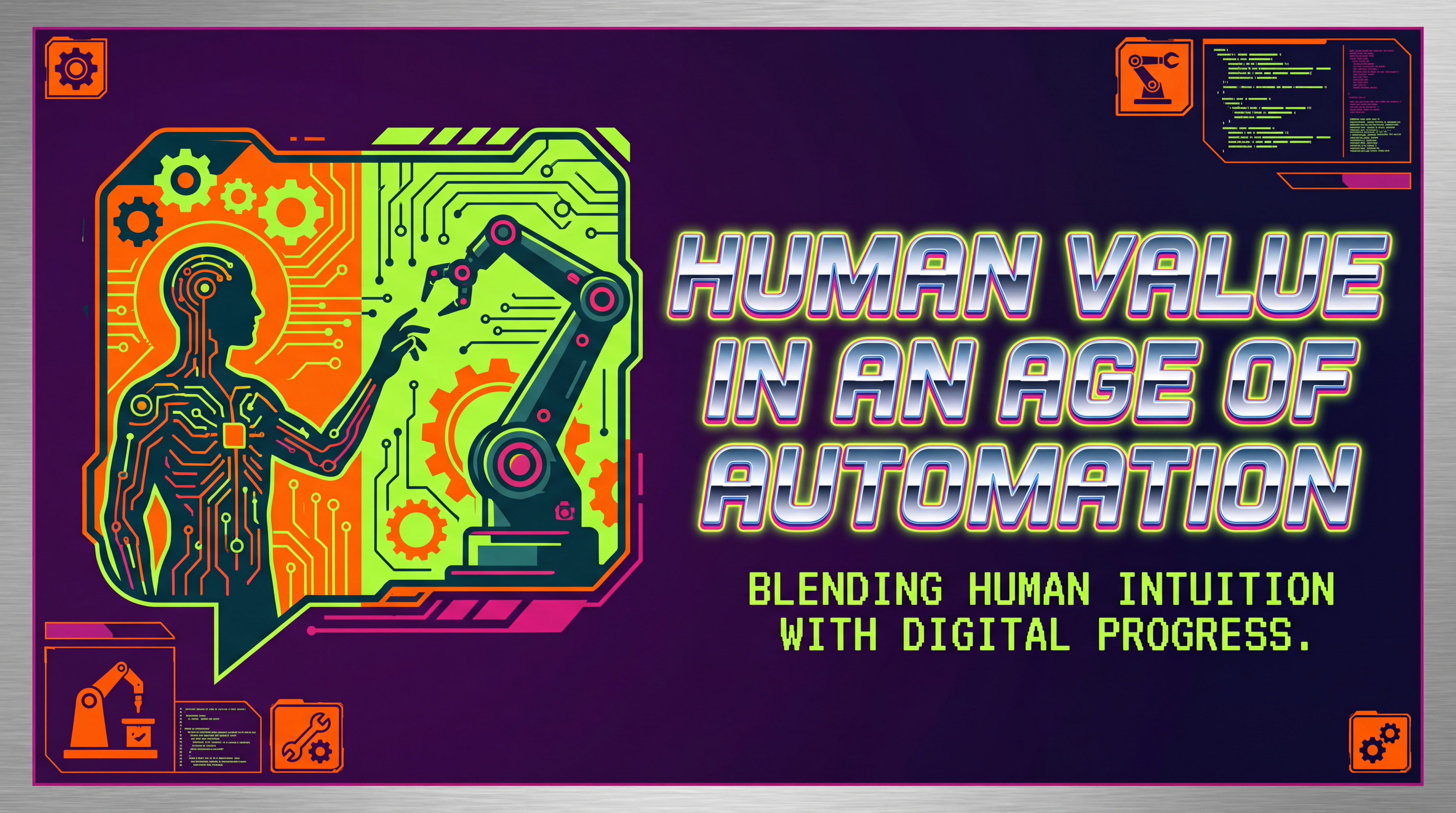
We live in a strange moment where two arguments keep colliding.
The first argument says that whenever something can be automated, it should be. If a machine can do a task faster, cheaper, and more consistently, then the human should be removed from the process. Efficiency becomes the highest value. The ideal system, under this logic, is the one with the fewest people in it.
The second argument says AI makes mistakes, hallucinates facts, misstates numbers, and sometimes speaks with unearned confidence. Therefore, it should not be trusted. The ideal knowledge system, under this logic, is one that avoids AI because imperfection makes it dangerous.
Both arguments sound smart at first. Both are incomplete.
The real world is messier than that. Humans do not optimize only for efficiency, and useful tools do not need to be perfect to create enormous value. Those two truths belong together. In fact, they explain a lot about the future we are heading into.
A machine can often produce an output more efficiently than a person. That much is true. But in many systems, the output is not the only thing that matters. Sometimes the human presence is part of the value. Sometimes the human role is the point. And sometimes people deliberately keep humans inside a system, even when automation is possible, because removing the person removes meaning, trust, taste, dignity, ritual, emotional connection, or moral ownership.
At the same time, AI can still be worth using even when it hallucinates. Humans also misremember, exaggerate, misunderstand, bluff, distort, and pass along bad information with total confidence. The existence of error does not disqualify a tool. The real question is whether the value it creates outweighs the damage its errors cause, assuming the user has enough judgment to know when to trust, when to verify, and when a rough answer is good enough.
That is the deeper idea underneath both conversations: perfection is not the standard. Net value is.
Humans are not just inefficiencies waiting to be removed
There is a fantasy hidden inside a lot of modern thinking. It goes like this: once we can automate a task, any continued use of humans is sentimental, irrational, or temporary. Eventually, if we are smart enough, we will remove the human bottleneck and end up with a cleaner system.
That fantasy misunderstands what many systems are actually for.
A restaurant is not only a calorie-delivery system. A teacher is not only a content-distribution system. A therapist is not only a pattern-matching advice engine. A judge is not only a sentencing calculator. A musician is not only a sound generator. A parent is not only a child-management device.
When people say they want a human, they are often not saying the machine cannot technically perform the task. They are saying the task itself changes when the human disappears.
This matters because our culture often treats humans as though they are just sloppy versions of machines. We compare the person to the computer on speed, consistency, scale, and cost, and then act shocked when the person loses. Of course the person loses on those terms. That was never the full contest.
The fuller contest is about what kind of world we want to live in. A world optimized only for output is not automatically a world optimized for human flourishing. Sometimes the value is not in the result alone. It is in being seen, being guided, being understood, being served, being judged by another conscience, being moved by another soul, being part of something made by human hands.
This is why handcrafted goods still matter. A machine can mass-produce furniture, watches, pottery, paintings, leather goods, and clothes with incredible efficiency. Yet people still pay extra for the handmade version. Why? Not because the machine could not make an equally functional object. Because the human labor is part of the product. The imperfections themselves become evidence of touch, care, intention, and time.
The same thing happens in food. A system could automate enormous parts of cooking. Some already do. But many people still want a chef, a bartender, a baker, a server, or a host. The meal is not just nutritional output. It is atmosphere, mood, creativity, hospitality, and presence. A machine can deliver calories. A person can make the evening mean something.
Live music is another obvious example. Computers can generate music. Speakers can reproduce it with flawless consistency. But people still pack concert venues to hear human beings sing, strain, improvise, miss notes, recover, and create something in real time. The audience is not paying only for sound. They are paying for expression, risk, vulnerability, energy, and the fact that another human being is making that experience happen now.
Even older systems reveal the same pattern. Elevator operators continued to exist after elevators could be automated. Bank tellers still exist after ATMs could handle much of their function. Travel agents survived online booking. Cashiers persisted despite self-checkout. In each case, the machine could do more of the task than many people admitted. Yet humans stayed in the loop because reassurance, status, service, trust, familiarity, and the desire not to turn every interaction into unpaid customer labor all mattered.
This tells us something important: efficiency is only one value among many. Humans often choose systems that are less efficient because those systems preserve something they care about more.
The hidden value of human participation
The strongest way to say it is simple: humans do not merely want outcomes. They want involvement.
A fully automated system can look ideal on paper and still feel dead in practice. It can remove friction while also removing agency, personality, warmth, ownership, and meaning. Sometimes the “inefficiency” is what makes the experience human.
Think about teaching. A machine can explain math, summarize history, quiz a student, and adapt lessons to a learner’s pace. That is all useful. But a teacher does more than transfer information. A teacher notices shame, boredom, discouragement, curiosity, fear, pride, confusion, and social dynamics in a room. A teacher helps shape not just what a student knows, but how that student sees themselves. Machines can assist that process. They do not fully replace what people mean when they say, “I had a great teacher.”
Or take therapy. An AI may eventually become surprisingly competent at certain kinds of reflective conversation, journaling prompts, cognitive reframing, and emotional pattern recognition. But many people will still want a human therapist because they do not just want correct structure. They want to be witnessed by another person. They want understanding that feels lived. The relationship is not a side feature. It is part of the medicine.
Then there is law, one of the clearest examples of where people resist pure automation even when consistency would improve. A machine could assist with pattern analysis, precedent lookup, sentencing ranges, and risk calculations. But most societies recoil from the idea of handing major moral decisions entirely to algorithms. Why? Because justice is not experienced as a spreadsheet. People want mercy, context, accountability, and the knowledge that another human being bears the moral weight of the choice.
Luxury markets understand this better than tech utopians often do. Recommendation engines can suggest clothes, wine, art, fragrance, and furniture. But high-end buyers still want stylists, sommeliers, curators, gallerists, and personal shoppers. In luxury, taste is not just selection. It is social recognition. The buyer wants to be understood by another human with refined judgment. Being guided is part of the value.
Sports offer another case. Cameras, sensors, and software can track motion better than the human eye. Yet people still want human coaches and often human refs because sports are not just optimization problems. They are theater, leadership, psychology, rhythm, momentum, and drama. People do not only want accurate decisions. They want a human story.
Once you start seeing this, it becomes obvious that many systems are not designed only to maximize output. They are also designed to preserve human participation. That is not a bug in the system. It is one of the reasons the system exists.
The mistake people make about AI hallucinations
Now flip the conversation.
A lot of people hear that AI hallucinates and immediately conclude that it is fundamentally untrustworthy. Since it can be wrong, it should not be used for serious thinking. That argument has the same flaw as the automation argument. It takes one real characteristic of the tool and treats it as the whole story.
Yes, AI hallucinates. It can invent citations, blur details, overstate certainty, and confabulate facts. That is real. It matters. Anyone using it seriously needs to understand that.
But humans do versions of the same thing all the time.
People answer questions they do not fully understand. They speak confidently from vague memory. They compress nuance into slogans. They repeat things they heard from a friend, a headline, or a half-remembered documentary. They use tone to disguise uncertainty. They confuse familiarity with truth. They mistake coherence for accuracy.
The point is not that AI and humans fail in identical ways. They do not. The point is that error is not unique to AI. So the correct question is not, “Does this system ever produce wrong answers?” Every knowledge system does. The correct question is, “What kind of value does this system create relative to its failure rate, and do I know how to manage that failure rate?”
That is a much more serious question.
A useful tool does not need perfect accuracy. It needs positive net value.
This becomes obvious once you realize that not every task requires the same level of certainty. If you are using AI to brainstorm, simplify a concept, compare frameworks, generate names, draft an outline, summarize a field, or get your bearings on a topic, one wrong number may not matter much. You are using it for orientation, exploration, or synthesis. The utility comes from speed and breadth.
But if you are using AI for legal advice, medical decisions, tax strategy, contracts, precise quotations, historical specifics, or technical implementation where one bad detail changes the outcome, then hallucinations matter a lot. In those contexts, the tolerance for error is much lower.
The mature position is not “ignore hallucinations.” It is “match the required accuracy to the task.”
That is exactly how people already handle human sources, whether they realize it or not. You do not ask a friend at dinner for a legally binding answer. You do not treat a salesperson like a sworn expert. You do not use a rough news summary as your only source for surgery decisions. Humans already calibrate trust constantly. AI just makes that calibration more urgent and more explicit.
The real skill is calibrated trust
The people who will get the most out of AI are not the ones who worship it and not the ones who dismiss it. They are the ones who develop intuition about it.
A good AI user learns what the tool is good at, where it tends to bluff, when a clean answer feels suspiciously clean, when the structure is useful even if the details need checking, and when precision matters enough to slow down. This is not blind trust. It is calibrated trust.
That phrase matters.
Calibrated trust means you do not need AI to be perfect to benefit from it. You only need to know the terrain. You need a feel for its strengths, its blind spots, and its failure patterns.
Used that way, AI becomes less like an oracle and more like a high-speed cognitive amplifier. It helps you explore possibilities, compress complexity, and move faster through the early and middle stages of thinking. It gives you leverage. But like any amplifier, it can magnify noise too. The user has to know when they are in low-risk territory and when they are walking into danger.
This is why the “AI hallucinates, therefore it is worthless” argument is weak. It mistakes nonzero error for zero value. That is not how serious people evaluate tools.
A business owner does not reject an employee because the employee can make mistakes. A driver does not refuse to use a car because accidents are possible. A researcher does not throw away a promising method because it requires judgment. The right question is always comparative: compared to the alternatives, what do I gain, what do I risk, and do I know how to manage the tradeoff?
That is the right way to think about AI.
Why imperfect AI may still be the rational choice
Suppose AI steers you wrong some percentage of the time. Fine. That is not ideal, but it does not settle the question. You still have to ask what relying only on humans, search engines, books, coworkers, or traditional workflows would cost you.
Maybe those alternatives are slower. Maybe they are fragmented. Maybe they require more effort to gather, compare, and synthesize. Maybe they are also wrong more often than people admit. Maybe they leave you with far fewer explored possibilities in the same amount of time.
Now the decision becomes clearer. If AI lets you cover ten times as much conceptual ground, generate first drafts instantly, compare models rapidly, clarify confusing ideas, and start from momentum instead of from a blank page, then even a significant error rate may still leave it with overwhelmingly positive value, assuming you verify what actually matters.
That is not irrational. That is expected value thinking.
You are not asking whether AI is flawless. You are asking whether the speed, breadth, and leverage it provides create more good than the mistakes destroy. In many contexts, the answer is yes.
That does not mean every use case is safe. It means the conversation should stop pretending that “sometimes wrong” and “not worth using” are the same thing.
They are not.
In fact, the future may belong to people who become extremely good at extracting value from imperfect AI the same way skilled people have always extracted value from imperfect humans: by noticing when the source is likely to be reliable, when it is likely to bluff, and when the cost of being wrong is low enough that rough guidance is still worth taking.
This is a form of judgment, and judgment has always mattered more than raw access to information.
The deeper connection between both ideas
At first glance, these two conversations seem unrelated. One is about why we keep humans in systems. The other is about why we use AI despite hallucinations. But they are actually connected by the same underlying mistake.
The mistake is reducing everything to one metric.
In the first conversation, people reduce systems to efficiency and assume that any continued use of humans is backward. In the second conversation, people reduce tools to accuracy and assume that any error makes a tool unusable. Both positions flatten reality.
Human systems are not built only for efficiency. Knowledge tools are not judged only by whether they are perfect. Real life is built on tradeoffs, context, and layered values.
We keep humans in systems because humans provide things machines cannot fully replace: meaning, emotional presence, moral responsibility, taste, ritual, trust, and the dignity of participation.
We use AI despite its imperfections because tools do not need perfection to be transformative. They need enough usefulness to justify their risk, and users need enough judgment to navigate the danger zones.
This is the balanced position our time demands. Not machine worship. Not machine panic. Not efficiency absolutism. Not perfection absolutism.
A mature society will learn to automate what should be automated, preserve what should remain human, and use imperfect intelligence systems with clear eyes instead of magical thinking.
That is harder than either extreme because it requires discernment. You have to ask what the system is for. You have to ask what counts as value. You have to ask where error is acceptable and where it is intolerable. You have to decide when speed matters more than certainty and when certainty matters more than speed.
Those are human questions. They do not disappear in the age of AI. If anything, they become more important.
The real future is not human versus machine
The cheap version of the future is a fight between human beings and machines. Either the machine wins and replaces us, or we resist and defend our place. That story is dramatic, but it misses the more interesting reality.
The future is not just about replacement. It is about design.
What kind of systems will we build? Which roles will we automate because they are repetitive, dangerous, demeaning, or unnecessarily slow? Which roles will we preserve because the human presence is inseparable from the value created? Which decisions will we delegate to machines, and which ones will we insist remain human because responsibility itself matters?
And how will we use AI in our own thinking? Will we dismiss it because it is imperfect, or will we learn to use it like adults use every powerful imperfect tool: aggressively where the upside is high, cautiously where the downside is high, and never without judgment?
That is the real divide.
The future belongs neither to people who think humans are obsolete nor to people who think imperfect AI is worthless. It belongs to people who understand tradeoffs. People who know that speed is not the only value and accuracy is not the only metric. People who can preserve the human where the human matters most and embrace machine leverage where leverage matters most.
In the end, the goal is not to build a world with no humans in the loop. It is to build a world where humans are in the right loops.
And the goal is not to find a source that never fails. It is to become the kind of thinker who can use powerful imperfect sources without becoming their victim.