Dev log
Is AI Making Us Stupid—or Teaching Us to Think at a Higher Level?
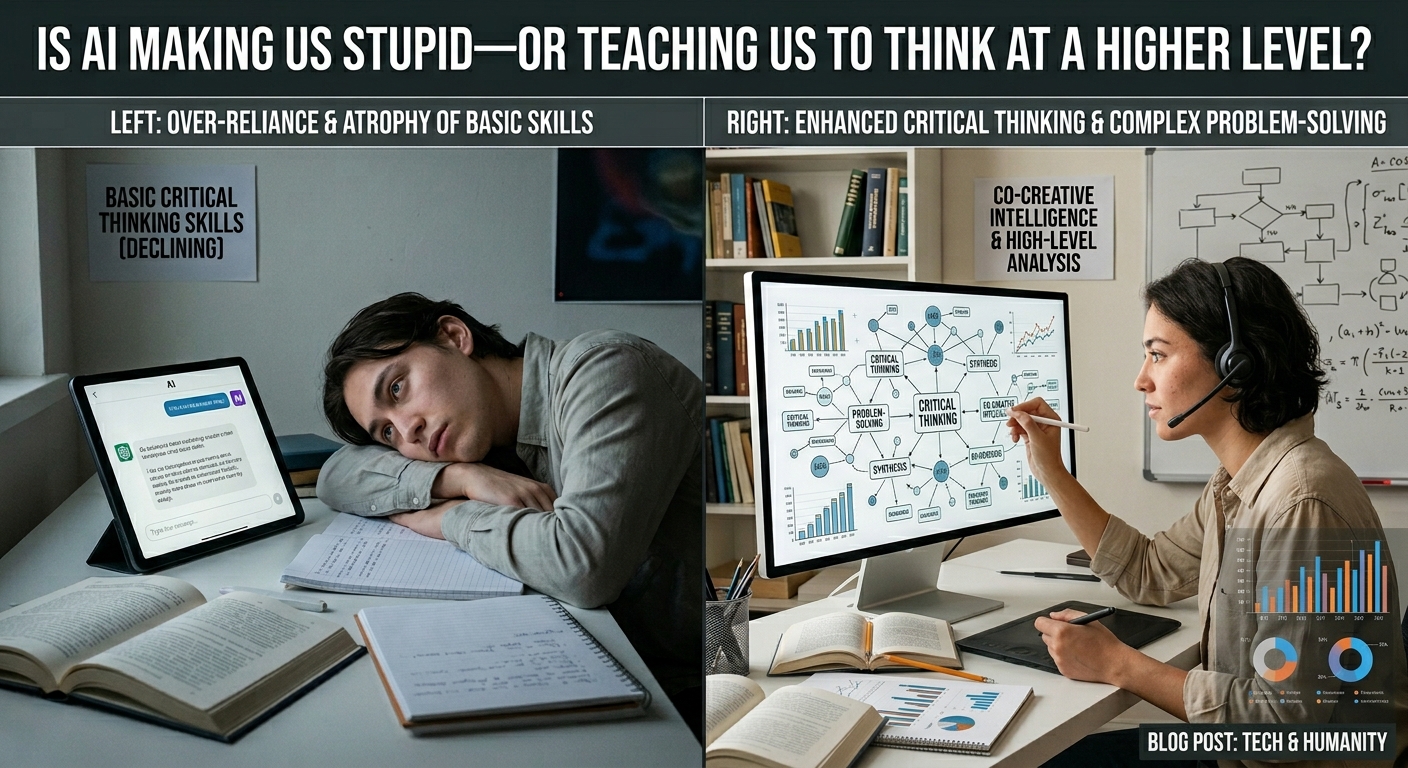
Every major technology that changes how humans think eventually produces the same fear.
People worried that writing would weaken memory. Calculators were accused of ruining arithmetic. Search engines supposedly made people stop remembering things. GPS made us worse at navigation. Smartphones became shorthand for shrinking attention spans.
Now artificial intelligence has become the latest target.
You hear versions of the same argument everywhere:
“People don’t have to think anymore.”
“AI is frying our brains.”
“Everyone is going to become dependent on it.”
“If a machine writes, codes, researches, and solves problems for you, eventually you won’t be able to do anything yourself.”
There is some truth buried inside those concerns.
But the larger picture is much more complicated.
AI can absolutely make certain skills weaker if we stop practicing them. It can encourage intellectual laziness. It can allow people to produce work they barely understand. It can even make someone appear more capable than they really are.
At the same time, AI can dramatically expand what a person is capable of building, understanding, exploring, and accomplishing.
The important question therefore isn't:
**Does AI make people smarter or dumber?**
A better question is:
**What kinds of thinking are we giving up, and what kinds of thinking are replacing them?**
That distinction may determine whether AI becomes one of humanity's greatest intellectual tools—or one of its greatest intellectual crutches.
---
AI Can Improve Performance Without Improving Understanding
One of the easiest mistakes in this discussion is confusing **performance** with **knowledge**.
Suppose someone who has never programmed asks an AI system:
> Build me a website that tracks inventory and generates reports.
Twenty minutes later, they have a working prototype.
Their ability to produce software has increased enormously.
But their knowledge of programming may have barely changed.
If you removed the AI, they might not know how to rebuild it.
That distinction matters.
Research is beginning to show exactly this kind of effect.
Studies involving students using generative AI have found that AI can significantly improve performance while the tool is available. But when the AI is removed, some users perform worse than people who learned without it.
That shouldn't be surprising.
If the machine is solving the difficult parts of the problem, the human doesn't necessarily practice those difficult parts.
The same principle applies almost everywhere.
If AI writes every email for you, your unaided writing ability may decline.
If AI writes every line of your code, your memory for programming syntax may weaken.
If AI summarizes everything you read, your ability to carefully extract information from long documents may get worse.
If AI performs every calculation, your mental arithmetic may become slower.
If AI always forms the first opinion, you may become less practiced at forming your own.
Those are legitimate concerns.
But they still don't prove that your overall intelligence is declining.
Something else may be happening.
---
Your Brain Has Always Outsourced Work
Human beings have been cognitively outsourcing tasks for thousands of years.
Writing is probably the most obvious example.
Before widespread writing, enormous amounts of information had to be memorized.
Stories, laws, genealogies, traditions, instructions, and history were transmitted through human memory.
Writing allowed civilization to store memory outside the brain.
Instead of remembering thousands of facts, humans could write them down and retrieve them later.
Technically, that reduced the need for certain kinds of memory.
But almost nobody today argues that civilization would be intellectually superior if books had never been invented.
Writing freed the human brain to do other things.
The same happened with mathematics.
A spreadsheet can perform calculations that once required hours of manual work.
A calculator can solve arithmetic instantly.
Software can analyze millions of records that no human being could realistically process manually.
GPS can navigate a complicated city without requiring you to memorize every street.
Search engines allow you to retrieve information without memorizing the location of every fact.
These technologies are examples of something psychologists call **cognitive offloading**.
We move some portion of thinking, remembering, or calculating into an external system.
AI is simply a much more powerful version of this phenomenon.
And that is precisely why it feels different.
A calculator outsources arithmetic.
AI can outsource pieces of:
writing,
coding,
research,
reasoning,
planning,
design,
analysis,
brainstorming,
translation,
organization,
and decision support.
We have never had a general-purpose cognitive outsourcing technology this powerful.
That creates enormous opportunities—and new risks.
---
The Real Change May Be Abstraction
Imagine a programmer working twenty years ago.
They might spend their day thinking about:
syntax,
memory management,
database queries,
APIs,
server configuration,
debugging,
and implementation details.
Now imagine someone building software with modern AI assistance.
They might spend much less time remembering syntax.
Instead, they spend more time thinking about:
What problem should this solve?
Who will use it?
What information should flow through the system?
What happens when something fails?
What should the user experience look like?
How should different services communicate?
What should be automated?
What should remain under human control?
How do we verify that the output is correct?
This is not necessarily **less thinking**.
It is thinking at a different level.
In engineering and computer science, we often describe this as working at a higher level of **abstraction**.
Consider driving.
A person designing an engine thinks about fuel injection, compression ratios, combustion, cooling, lubrication, and mechanical tolerances.
The person driving the car does not need to consciously think about any of those things.
They operate at a higher abstraction:
accelerate,
brake,
steer,
navigate.
Technology hides lower layers so humans can focus on higher layers.
Software itself works this way.
Modern programmers rarely manipulate individual electrical signals inside a processor.
Programming languages hide those details.
Operating systems hide hardware complexity.
Cloud platforms hide server infrastructure.
Frameworks hide huge amounts of repetitive programming.
AI appears to be creating another abstraction layer.
Instead of telling the computer exactly **how** to perform every operation, humans increasingly describe **what they want accomplished**.
That is a profound shift.
---
Moving Up an Abstraction Isn't Automatically Becoming Smarter
This distinction is important.
Higher abstraction is powerful.
But abstraction without understanding can also become dangerous.
Imagine someone asking AI to build a financial system.
The system works.
The person does not understand the database.
They don't understand authentication.
They don't understand security.
They don't understand financial calculations.
They don't understand the code.
Everything appears fine.
Then something fails.
They have no idea why.
They cannot recognize a dangerous design decision because they never understood the layer beneath the abstraction.
That is the weakness of relying too heavily on AI.
You can gain **capability without gaining competence**.
AI makes it possible to operate machinery you don't fully understand.
Sometimes that's perfectly acceptable.
You don't need to understand semiconductor manufacturing to use an iPhone.
But the closer the technology comes to important decisions, money, safety, medicine, infrastructure, or security, the more dangerous complete ignorance becomes.
The goal therefore shouldn't be:
**Never rely on AI.**
Nor should it be:
**Let AI do everything.**
The healthier approach is:
**Understand enough of the layers beneath you to supervise the system intelligently.**
---
The Pilot and Autopilot Model
Modern aviation provides a useful analogy.
Commercial airplanes use enormous amounts of automation.
Pilots don't manually control every aspect of the aircraft throughout an entire flight.
Automation manages navigation, altitude, speed, engine systems, and countless other operations.
This doesn't mean pilots are useless.
Their role moved upward.
Pilots monitor systems.
They interpret conditions.
They make decisions.
They manage unexpected situations.
They understand what the automation is doing.
And importantly, they can recognize when the automation is wrong.
That last ability is critical.
AI users increasingly occupy a similar position.
The goal isn't necessarily to manually perform every task.
The goal is to understand the system well enough to judge its output.
A good AI user should be able to ask:
Does this answer make sense?
What assumptions did the system make?
What could be wrong?
What information is missing?
How could I test this?
What would happen under unusual conditions?
Is there another solution?
Can I explain why this solution works?
That is not passive thinking.
It is supervisory thinking.
And supervisory thinking becomes increasingly important as machines perform more execution.
---
There Are Two Very Different Ways to Use AI
Imagine two people using the exact same AI system.
Person One
They receive an assignment.
They paste it into AI.
They copy the answer.
They barely read it.
They submit it.
Next assignment.
Over time, they practice very little writing, reasoning, research, or problem solving.
AI has replaced their thinking.
Person Two
They encounter a problem.
They explain it to AI.
AI proposes several solutions.
They question the assumptions.
They ask for alternatives.
They research unfamiliar concepts.
They test prototypes.
Something fails.
They investigate why.
They modify the system.
They connect the new idea to another problem.
Eventually they build something they previously couldn't have built.
AI has expanded their thinking.
The technology is identical.
The cognitive behavior is completely different.
This is why saying “AI makes people stupid” is too simplistic.
AI is a multiplier.
But multiplication depends heavily on what you multiply.
Curiosity × AI can become extraordinary learning.
Creativity × AI can become rapid experimentation.
Expertise × AI can become enormous productivity.
Laziness × AI can become convincing mediocrity.
Ignorance × AI can become confident mistakes.
The tool amplifies the behavior surrounding it.
---
AI Can Create an Illusion of Intelligence
One legitimate danger deserves particular attention.
Generative AI can allow someone to produce work far beyond their personal understanding.
A person can generate:
professional reports,
software,
legal-sounding documents,
financial analysis,
scientific explanations,
marketing strategies,
and technical proposals.
The output may sound sophisticated.
That can create an illusion:
**“Because I produced this, I understand it.”**
But producing something through AI and understanding it are not the same thing.
This may become one of the most important intellectual disciplines of the AI era.
We will need to distinguish between:
**output capability**
and
**internal understanding.**
The safest test is simple:
Can you explain it?
Not every implementation detail.
But can you explain the major reasoning?
Why does this architecture make sense?
Why did you choose this strategy?
What are the tradeoffs?
Where might it fail?
What assumptions are being made?
If you cannot explain any of those things, you may be operating beyond your understanding.
That doesn't mean you shouldn't use AI.
It means you should recognize where your knowledge ends.
---
Skill Atrophy Is Real—and Sometimes That's Fine
Technology frequently makes old skills weaker.
Most people today cannot navigate using the stars.
Few people can perform long multiplication faster than a calculator.
Few writers memorize hundreds of phone numbers.
Most drivers couldn't repair a modern transmission.
Yet society didn't collapse because those skills disappeared.
We replaced some skills with others.
The difficult question is deciding **which skills are safe to lose**.
You probably don't need to memorize hundreds of programming commands if AI can retrieve them instantly.
But understanding how software logic works is still valuable.
You may not need to manually calculate every financial model.
But understanding percentages, risk, compounding, and probability still matters.
You may not need to write every sentence without assistance.
But being able to recognize clear reasoning and good communication remains valuable.
You may not need to remember every fact.
But knowing enough about a subject to recognize misinformation is essential.
A useful principle is:
**Let AI replace mechanical recall before it replaces conceptual understanding.**
Syntax is cheaper to outsource than judgment.
Boilerplate is cheaper to outsource than architecture.
Formatting is cheaper to outsource than reasoning.
Information retrieval is cheaper to outsource than understanding.
Execution is cheaper to outsource than responsibility.
---
AI May Actually Increase Curiosity
There is another side of the equation that gets discussed far less.
Historically, curiosity was expensive.
Imagine wanting to understand quantum physics thirty years ago.
You might need to find a library.
Locate the correct textbook.
Understand the terminology.
Find someone capable of explaining the difficult parts.
Work through hundreds of pages.
Most people simply wouldn't bother.
Today you can ask:
“Explain quantum entanglement like I'm twelve.”
Then:
“Now explain it at the college level.”
Then:
“I don't understand the measurement part.”
Then:
“Give me an analogy.”
Then:
“Where does that analogy break down?”
Then:
“Show me the mathematics.”
The cost of asking another question has collapsed.
That matters.
People can now explore subjects far outside their formal education.
An artist can explore programming.
A programmer can explore biology.
A business owner can explore statistics.
A teenager can explore astronomy.
An engineer can learn economics.
AI creates an interactive intellectual environment where questions generate more questions.
Used this way, AI doesn't suppress curiosity.
It rewards it.
---
Building Is a Form of Thinking
One reason some heavy AI users feel intellectually stronger rather than weaker is that AI radically reduces the distance between an idea and an experiment.
Previously, someone might think:
“It would be interesting to build an application that does this.”
Then reality intervened.
They needed programming skills.
Infrastructure.
Database knowledge.
Design.
APIs.
Hosting.
Debugging.
Money.
Time.
The idea died before becoming an experiment.
AI changes that equation.
Now someone can move:
idea → prototype → test → failure → modification → new prototype
in hours instead of weeks.
That creates a powerful learning loop.
And experimentation is itself a form of thinking.
You learn things from building that you cannot learn from simply reading.
You discover hidden constraints.
You encounter edge cases.
You learn where your assumptions were wrong.
You refine the problem.
You find better questions.
This is one reason AI can feel like a cognitive superpower.
It drastically increases the number of intellectual experiments one person can run.
---
The Future Skill May Be Knowing What to Ask
For much of modern education, intelligence has been strongly associated with knowing answers.
But when machines can retrieve and generate answers almost instantly, another skill becomes increasingly valuable:
**knowing what questions matter.**
Consider the difference between these two questions:
“How do I make a dashboard?”
and:
“What decisions should this dashboard help someone make, and what information would they need to make those decisions correctly?”
The second question exists at a higher abstraction.
The technical implementation matters.
But defining the right problem may matter even more.
AI makes answers cheaper.
That increases the value of:
problem selection,
judgment,
taste,
systems thinking,
curiosity,
verification,
strategy,
and question formation.
These have always mattered.
AI simply makes their importance more obvious.
---
The Biggest Danger Is Losing Your Ability to Judge
There is one cognitive ability I would protect above almost everything else:
**judgment.**
If AI eventually becomes better than humans at writing, coding, analysis, design, and research, the human still needs some ability to judge what the machine produces.
The dangerous user is not the person who uses AI constantly.
The dangerous user is the person who can no longer tell when AI is wrong.
Once that happens, automation stops being leverage.
It becomes dependence.
This is why domain knowledge still matters.
You don't necessarily need to outperform the machine at execution.
You need enough understanding to recognize:
bad assumptions,
hallucinations,
poor logic,
security problems,
ethical issues,
missing information,
and unintended consequences.
Think of AI as having an extremely capable junior employee who can work at incredible speed but occasionally makes bizarre mistakes.
You wouldn't manually redo every task the employee performs.
But you also wouldn't stop understanding your own business.
---
A Simple Rule for Healthy AI Use
There is a useful way to evaluate your relationship with AI.
After using it heavily, ask yourself:
**Can I explain what happened?**
**Can I recognize when the answer doesn't make sense?**
**Do I understand the important concepts?**
**Am I asking increasingly better questions?**
**Am I using the time saved to solve larger problems?**
**Could I function reasonably well if the tool disappeared temporarily?**
**Am I deciding what matters, or am I letting the machine decide everything?**
If your answers are mostly positive, AI is probably functioning as cognitive leverage.
If your answers are mostly negative, you may be outsourcing too much.
---
Don't Protect Every Old Skill Just Because It Is Old
There is also a danger in romanticizing difficulty.
Humans sometimes confuse effort with value.
If something once required ten hours and AI reduces it to ten minutes, some people instinctively feel that something important was lost.
Sometimes something was lost.
But sometimes we simply eliminated unnecessary labor.
Nobody argues that accountants should abandon spreadsheets because manually adding columns exercises the brain.
Nobody insists architects calculate every structural equation by hand.
Nobody believes programmers should return to machine code because modern programming languages are intellectually lazy.
Progress frequently consists of moving humans away from repetitive execution toward higher-level decisions.
AI may simply be continuing that pattern at unprecedented speed.
The correct response isn't to preserve every difficult task.
It's to determine which difficulties were producing valuable thinking and which were merely consuming time.
---
Intelligence in the AI Era May Look Different
The definition of a highly capable person may gradually change.
The old model emphasized:
**I know how to do this.**
The emerging model may emphasize:
**I understand what needs to happen, I know how the pieces fit together, I know what tools to use, I can evaluate the results, and I can move from idea to outcome.**
That doesn't make foundational knowledge irrelevant.
It makes foundational knowledge part of a larger system.
A powerful AI user may know less programming syntax than an old-school developer while understanding more about product architecture.
They may remember fewer facts while exploring more subjects.
They may manually perform fewer tasks while completing vastly more projects.
They may know fewer implementation details while becoming better at connecting disciplines.
Whether this represents intellectual decline or intellectual evolution depends heavily on what replaces the outsourced cognition.
---
The Real Question
Artificial intelligence probably will make some people intellectually weaker.
People who use it to avoid reading, thinking, questioning, struggling, learning, and understanding may gradually lose some of those abilities.
That risk is real.
But AI will also make some people extraordinarily capable.
People who use it to explore ideas, challenge assumptions, learn unfamiliar subjects, build prototypes, automate repetitive work, connect disciplines, and test their thinking may operate at a level that previously required entire teams.
The dividing line isn't whether someone uses AI.
It's **how they use it**.
Technology has always changed the distribution of human intelligence.
Writing weakened the need for memorization while expanding civilization's ability to accumulate knowledge.
Calculators weakened manual arithmetic while enabling more advanced mathematics.
Computers eliminated enormous amounts of repetitive cognitive work while enabling entirely new industries.
AI may weaken some traditional cognitive skills as well.
But it may simultaneously push humans toward another layer:
from execution toward orchestration,
from memorization toward retrieval,
from syntax toward architecture,
from production toward judgment,
from answering questions toward deciding which questions matter.
That doesn't sound like the end of thinking.
It sounds like the definition of thinking is changing.
The goal should not be to prove that you can still perform every task the hard way.
The goal should be to preserve enough understanding that you remain in control of the abstraction above you and the machinery beneath you.
**Automate execution when it makes sense.**
**Automate repetition aggressively.**
**Use AI to increase the number of things you can explore and build.**
But be careful about outsourcing understanding, curiosity, judgment, and responsibility.
Those may become more valuable—not less—as artificial intelligence becomes more capable.
AI doesn't automatically make us stupid.
It gives us a choice.
We can use it to avoid thinking.
Or we can use it to think about bigger things.