Dev log
One Latte, Five Realities: Why Honest Witnesses Never Tell the Same Story
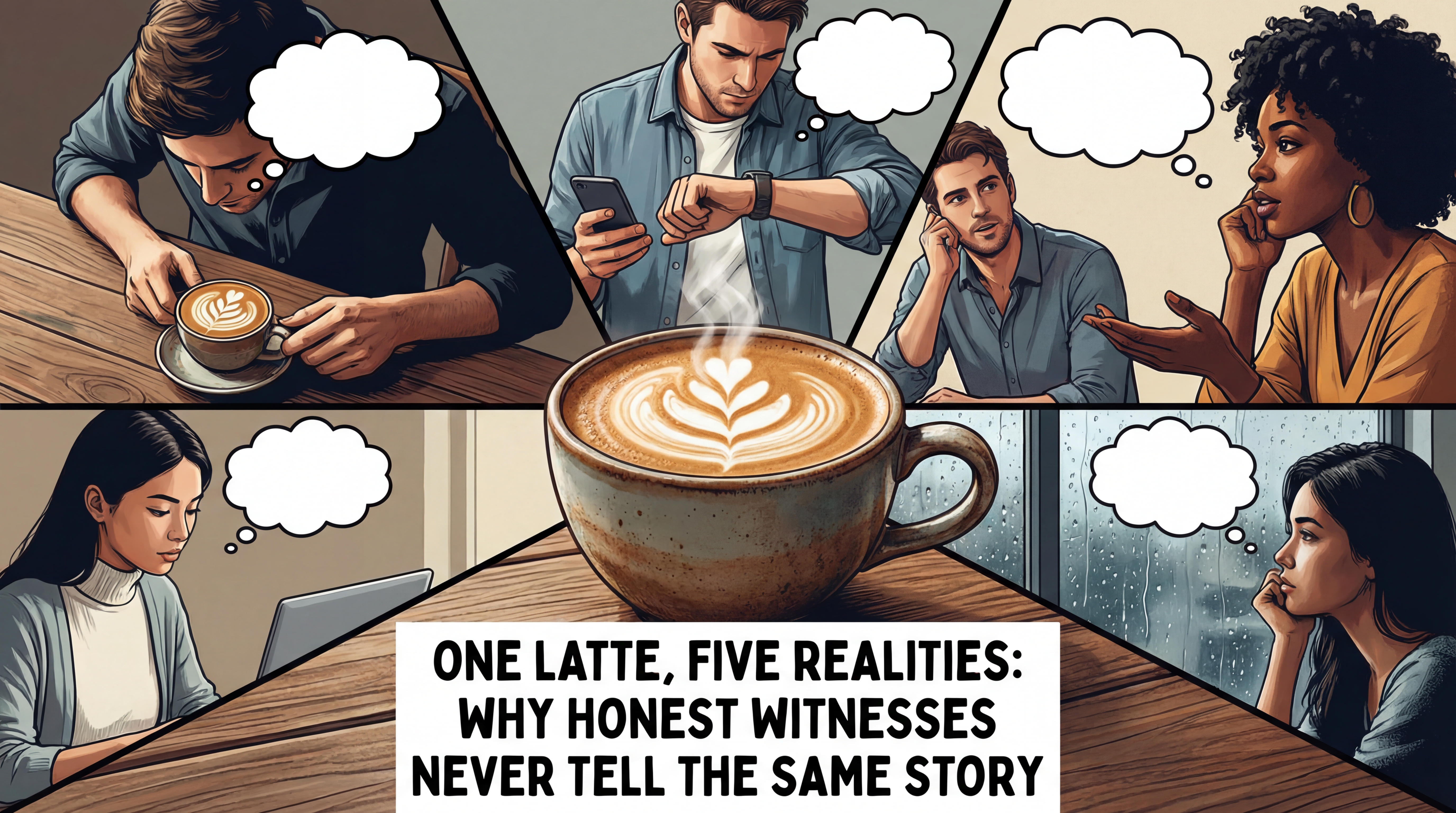
The universe, as it turns out, is under no obligation to make sense to you. But the real kicker? Even if it did make sense, your brain wouldn’t let you see it that way.
We like to think of our eyes as high-definition cameras and our memories as pristine hard drives. We believe that if three "honest" people stand on the same street corner and watch a dog trip a juggler, they should all go home with the same story.
They won’t. They never do.
This isn't just about people lying or being "dramatic." It’s about a fundamental glitch—or perhaps a feature—in the human hardware. From the way we perceive a twenty-second delay in a grocery line to the way we interpret a 38-second chaotic event in a city plaza, our "truth" is a cocktail of sensory data, past trauma, and the specific goals we had in mind the moment the chaos started.
Let’s take a leisurely stroll through the architecture of misunderstanding.
---
Scene 1: The Eight-Second Firestorm
The afternoon sun in Santa Monica has a way of turning the sidewalk into a sheet of silver glass. On the Third Street Promenade, the air smells like salt, expensive sunscreen, and the scorched-sugar scent of a nearby churro stand.
In the center of the walkway, a street performer in faded suspenders is finishing his set. He’s juggling three flaming torches. The "whoosh" of the fire as it cuts through the air creates a rhythmic, hypnotic pulse. A small crowd has gathered, their faces lit by the flickering orange glow.
Off to the side stands **Laila**. She’s holding a leash attached to **Bolt**, a sixty-pound Doberman with ears that seem to pick up radio signals from Mars. Bolt is vibrating. He isn't angry; he’s a "frustrated greeter." He sees the fire, he sees the movement, and his canine brain decides it’s time to join the party.
What happens next takes exactly eight seconds:
1. **The Snap:** Bolt spots a pigeon landing near the juggler. He lunges. The nylon leash, slick with sweat from Laila’s palm, snakes through her fingers.
2. **The Collision:** A commuter named **Maria** is walking past, clutching a pumpkin-spice latte and a zippered portfolio. She’s looking at her watch. Bolt’s shoulder clips her hip.
3. **The Explosion:** The latte takes flight. It performs two perfect mid-air revolutions before detonating against the juggler’s boots.
4. **The Bow:** The juggler, sensing a disaster, pivots. He catches the torches, drops into a deep theatrical bow right as the whipped cream settles on his shoelaces, and shouts, *"And for my next trick: The Vanishing Coffee!"*
The crowd cheers. The tension breaks. But the stories? They’re just beginning to diverge.
The Three Versions of "Truth"
That evening, three different accounts are recorded in the annals of human memory:
* **Maria (The Commuter):** She’s still shaking as she tells her husband, *"It was terrifying. This massive, aggressive dog snapped its leash and lunged at the performer. It almost mauled him. I was lucky I only lost my coffee; it felt like a total security failure."*
* **Devon (The Content Creator):** He was filming from across the street. He uploads the clip with the caption: *"BEST STREET PERFORMER SAVE 2026. Juggler uses fire to dodge a charging dog and a flying latte. Comedy gold. #SantaMonica #StreetMagic"*
* **Laila (The Owner):** She’s petting Bolt’s head, feeling guilty. She tells her partner, *"He just got a little excited about a bird. The juggler was so sweet about it—he actually made it part of the act. Everyone was laughing."*
No one is lying. Maria genuinely felt the "aggressive" energy because she was physically bumped and caught off guard. Devon saw a narrative arc (hero vs. chaos) because he was looking through a lens. Laila focused on the resolution because her brain needed to minimize her own embarrassment.
They aren't looking at a window; they are looking at a mirror of their own expectations.
---
Scene 2: The Grocery Store Time-Warp
If you think the "Observer’s Paradox" only happens during high-stakes drama, think again. It happens every time you stand in line at GreenLeaf Market.
It’s 6:12 p.m. on a Wednesday—the "Golden Hour of Grumpiness." **Aisha** is at the front of the line. She’s got strawberries, almond milk, and a very tight budget. When the strawberries ring up at $9.99 instead of the $5.99 she saw on the shelf, she stops.
> "Excuse me," she says softly to the cashier, **Marco**. "I think those were on sale."
Marco, who has been scanning barcodes for six hours straight, sighs. He radios the produce department. A twenty-second silence follows. Finally, the crackle of the radio confirms the price. He overrides it. Total time elapsed: 22 seconds.
The Perception Gap
**Aisha’s Perspective:** To her, the interaction was a victory. She saved four dollars—the price of her bus fare home. The 22 seconds felt like a brief, pleasant pause where she regained control of her finances.
**Mr. Chen (The Man Behind Her):** Mr. Chen’s back hurts. He’s been standing for fifteen minutes. To him, those 22 seconds were an eternity. In his mind, Aisha was "haggling over pennies" and "holding up the entire world." When he recounts the story later, he will swear he stood there for five minutes while a "difficult woman" argued with the staff.
**Marco (The Cashier):** To Marco, the 22 seconds didn't even happen. His brain was on autopilot. He was actually focused on the toddler three lanes over who had just dropped a sippy cup, creating a "thud" that sounded like a gunshot in the tiled acoustics of the store.
This is **Time Dilation**. Studies in cognitive psychology show that when we are bored or frustrated, our internal clock "over-counts" the pulses of the brain, making time feel stretched. When we are focused on a goal (like saving money), we are in "flow," and time compresses.
> **Statistic Check:** In a study published in *Psychological Science*, researchers found that participants under high stress overestimated the duration of a threatening stimulus by up to **30%** compared to a neutral one. If you’re scared of the dog or annoyed by the line, the clock literally runs slower for you.
---
Scene 3: 38 Seconds of Urban Pinball
Let’s escalate. Imagine a city plaza—a complex ecosystem of moving parts. At 5:14 p.m., a sequence of events triggers a chain reaction that lasts less than a minute.
* **0-5s:** A medical courier drone begins its descent toward a landing pad.
* **10s:** A skateboarder named Malik clips a café table. A metal water bottle falls, clattering down stone steps with a loud, metallic *bang-bang-bang*.
* **15s:** A woman’s helium balloon pops against a sharp tree branch. *Crack!*
* **20s:** A terrier, startled by the pop, lunges at the descending drone. Its owner trips, spilling iced coffee onto a street violinist. The violinist flinches, and her $900 carbon-fiber bow snaps against a stone planter.
* **30s:** A rideshare driver, hearing the "bangs" and "cracks," thinks he’s hearing gunfire. He leans on his horn for ten seconds straight to warn people.
* **38s:** The drone’s AI, sensing "unstable landing conditions," aborts and flies away, leaving its life-saving insulin shipment hovering in mid-air.
Five minutes later, the plaza is a mess of spilled coffee, ceramic shards, and arguing humans. Here is how the witnesses "coded" the event:
| Witness | Primary Focus | The "Villain" | Emotional Tone |
| --- | --- | --- | --- |
| **Retired Firefighter** | The Drone | The Skateboarder | Anger (Safety concern) |
| **Exchange Student** | The "Explosion" | Unknown Terrorist | Fear (Confusion) |
| **Street Violinist** | The Coffee | The Dog Owner | Grief (Financial loss) |
| **Product Designer** | The Water Bottle | The Manufacturer | Curiosity (Durable goods) |
| **Rideshare Driver** | The "Gunshots" | The Environment | Heroism (Protective) |
Each witness created a **narrative anchor**. The firefighter, trained to look for hazards, anchored on the drone. The student, unfamiliar with the city, anchored on the loud noises. The designer anchored on the one thing he understood—the physics of a falling bottle.
---
The Science: Why Our Brains Are "Lying" To Us
We aren't failing to see the truth; we are performing **Data Compression**. The world is too "loud" for our brains to process every pixel, every sound, and every smell. If you tried to record everything, your brain would fry like an overloaded circuit.
1. Spotlight Attention
Think of your consciousness as a dark stage. Your "Attention" is a single, narrow spotlight. Whatever the light hits is "Real." Everything in the shadows simply doesn't exist. If your spotlight is on your spilled coffee, you literally do not see the drone aborting its landing.
2. The Cross-Race Effect (CRE) and Bias
This is where the "Observer’s Paradox" takes a darker turn. Our "priors" (our past experiences and societal conditioning) act as filters.
* **Statistical Reality:** Research shows that people are significantly less accurate at identifying faces of a different race than their own. In a 2001 meta-analysis, researchers found that the odds of a false identification were **1.56 times greater** in cross-race vs. same-race identifications.
* This isn't necessarily conscious malice—it's a lack of "perceptual expertise." But when you combine this with stress, you get witnesses who "see" threats that aren't there or "miss" details that are staring them in the face.
3. Reconstructive Memory
Elizabeth Loftus, a titan in the field of memory research, proved that memory is not a video recording. It’s a **Wiki page** that anyone can edit—including you.
In one famous experiment, she showed people a film of a car accident.
* If she asked, *"How fast were the cars going when they **smashed**?"*, people reported high speeds and remembered seeing broken glass.
* If she asked, *"How fast were the cars going when they **hit**?"*, the reported speeds were lower, and no one remembered glass.
* **The catch?** There was no broken glass in the video. The word "smashed" edited their memory after the fact.
---
The Technology Trap: Can Sensors Save Us?
You might think, *"Fine, humans are messy. Let's just trust the cameras."* But technology has its own "priors." A CCTV camera mounted 20 feet up has a narrow field of view. It has a low frame rate—maybe 15 frames per second. In that "Urban Pinball" scenario, the camera might miss the exact millisecond the balloon popped, making it look like the dog lunged for no reason.
Even "objective" data like a GPS log can be noisy. It can show a car was at a specific coordinate, but it won't tell you *why* the driver swerved. To get the full picture, engineers use something called a **Kalman Filter**—a mathematical way of combining noisy sensor data with a "predicted state" to find the most likely truth. It’s essentially a mathematical version of a jury.
---
The Math of Perspective
For those who like to see the "source code" of reality, it all boils down to two concepts: one from statistics and one from physics.
1. The Bayesian Brain
Your brain is a "Bayesian Inference Engine." It calculates the probability of what it’s seeing based on two things: **Priors** (what you already know) and **Likelihood** (the new data coming in).
* : Your "Posterior" (The "Truth" you believe after seeing the event).
* : Your "Prior" (Your belief before the event—e.g., "Dobermans are scary").
* : The "Likelihood" (How much the actual visual data supports your belief).
If your **Prior** is strong enough, the actual evidence () almost doesn't matter. You will "see" what you expected to see.
2. Relativity of the Frame
Einstein taught us that even time and space change depending on your "frame of reference." If you are moving at a significant fraction of the speed of light, your clock will literally tick slower than the clock of someone standing on the sidewalk.
The **Lorentz Transformation** shows us the math:
While we aren't running at the speed of light on the Santa Monica Promenade, the *metaphor* holds. Your "velocity"—your emotional state, your goals, your cultural background—rotates your perspective of the event. Two people can look at the same "event-point" in spacetime and disagree on the timing, the intensity, and the meaning of what happened.
---
How to Live in a World of "Fake" Truths
If everyone is seeing a different movie, how do we ever agree on anything?
1. **Check Your "Prior":** Before you get angry at a headline or a witness, ask: *"What was I already expecting to see?"* If the news makes you feel immediately "right," your prior is doing the heavy lifting, not the evidence.
2. **Triangulate:** One witness is a guess. Two witnesses is a conversation. Five witnesses is a map. Look for the "Invariant Substrate"—the tiny details everyone agrees on (e.g., "The latte was pumpkin spice"). That is the only solid ground you have.
3. **The 3-Meter Rule:** When you're in an argument, try to imagine the scene from three meters to the left. Literally. How would the person who got splashed see it? How would the person who was late for the bus see it?
Conclusion: The Grand Synthesis
Next time you see a "latte-splash" incident in your own life—whether it’s a misunderstood email, a heated political debate, or a literal dog-induced disaster—pause.
Remember that you are a biological machine running on messy data and ancient software. Your "Truth" is just a high-probability guess. To claim you own the *absolute* truth is like declaring your specific coordinate in the universe is the center of everything.
Instead, trade lens caps. Swap stories. Compare scrapbooks. Because the real story isn't what Maria saw, or what Devon filmed, or what Laila remembered. The real story is the messy, beautiful, flaming-torch-filled space in between them all.