Dev log
The Architecture of Power: From Ancient Ruins to a Blueprint for the Future
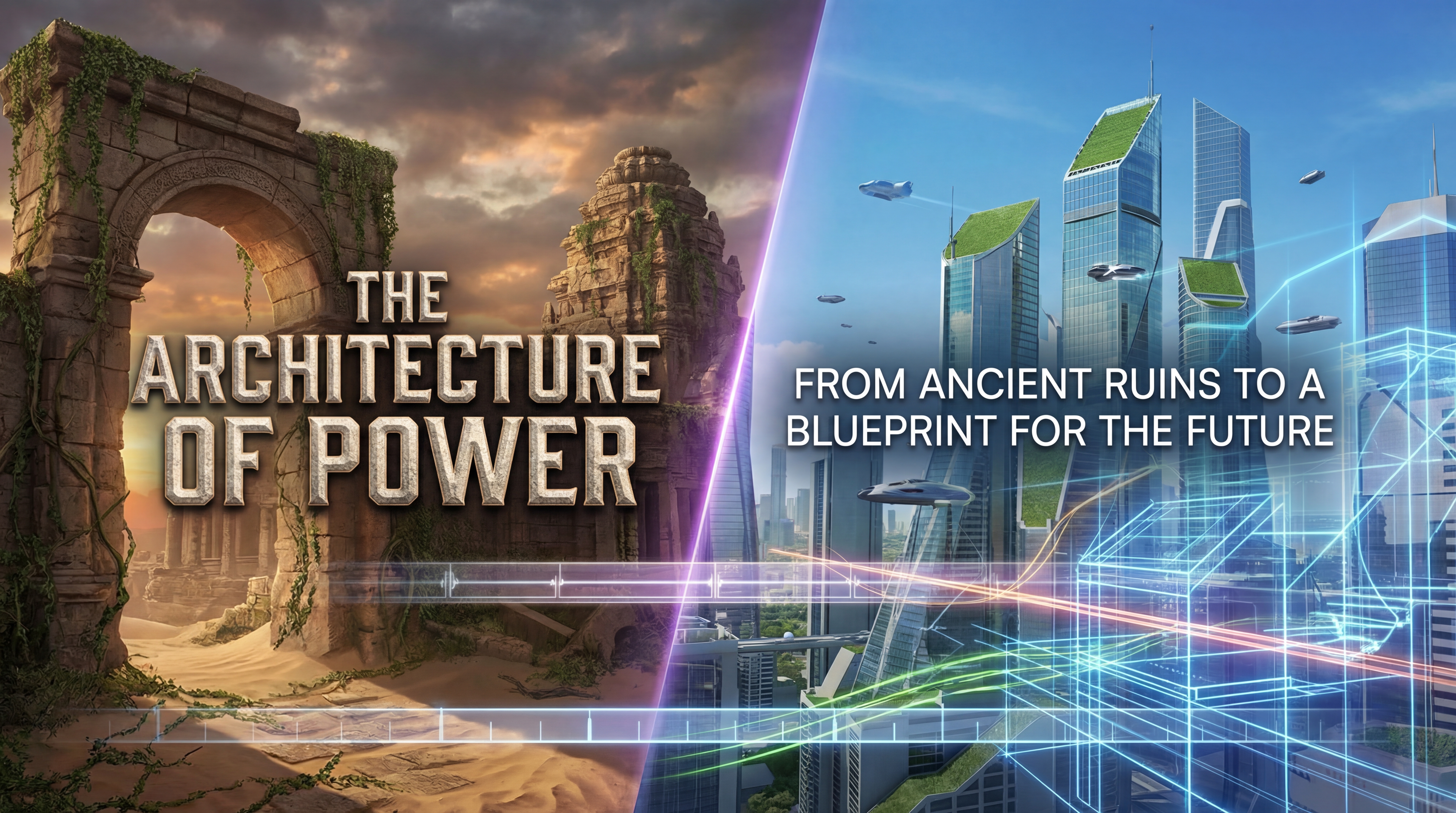
For as long as humans have gathered in groups larger than a single family, we’ve been obsessed with one question: **Who gets to be in charge?** Governance isn’t just about dusty law books or politicians in suits. It is the "operating system" of civilization. It determines who eats, who speaks, who is protected, and who is forgotten. From the spear-tipped authority of ancient chieftains to the algorithmic complexities of modern states, our history is a laboratory of power.
In this deep dive, we’re going to peel back the layers of human organization. We’ll explore the heavy hitters—Democracy, Communism, Capitalism—and look at the specialized systems like Theocracies and Meritocracies. Finally, we’ll move beyond the "standard" menu of options to propose a new vision: **The Collaborative Meritocratic Social Democracy (CMSD).**
---
1. The Classics: Power by the People (Or Their Proxies)
Democracy: The Great Athenian Experiment
The word itself is a power move: *demos* (people) and *kratos* (power). Born in the sun-drenched squares of 5th-century BCE Athens, democracy was a radical rejection of "might makes right."
* **The Vibe:** Direct participation. In Athens, if you were a citizen (a narrow definition at the time, excluding women, slaves, and foreigners), you didn’t just vote for someone to represent you; you showed up and voted on the laws yourself.
* **The Impact:** It birthed the idea of individual agency.
* **The Glitch:** Direct democracy is "slow." It’s hard to get 10,000 people to agree on a sewage tax without it turning into a shouting match. Furthermore, there is the "Tyranny of the Majority"—the risk that 51% of the people will vote to take away the rights of the other 49%.
The Republic: Rome’s Solution to Scale
As Rome grew from a city to an empire, they realized they couldn’t fit everyone in one square. They invented the **Republic**.
* **The Vibe:** "I’ll hire a guy for that." You elect representatives to do the heavy lifting of lawmaking. It introduced the concept of **Checks and Balances**—the idea that no one branch of government should have total control.
* **The Impact:** It’s efficient and scalable. Most modern "democracies" (like the US, France, or Germany) are actually Republics.
* **The Glitch:** The "Representative Gap." Sometimes the person you elect cares more about their donors or their own power than the people who put them there.
---
2. The Heavy Hands: Centralized Authority
Monarchy: The Luck of the Draw
For most of history, your leader was determined by who their parents were.
* **Absolute Monarchy:** The King’s word is literally law, often backed by "Divine Right."
* **Constitutional Monarchy:** Think the UK or Japan. The Monarch is a living logo—a symbol of national continuity—while the actual governing is done by an elected parliament.
* **The Impact:** Stability. You always know who is next in line.
* **The Glitch:** You might get a "Great" king, or you might get a "Mad" one. Relying on DNA for leadership is a high-stakes gamble.
Authoritarianism and Totalitarianism: Total Control
These systems usually emerge during chaos. When people are scared, they often trade their freedom for the promise of "order."
* **Authoritarianism:** Strong central power, limited political friction, and no real way to vote the leader out.
* **Totalitarianism:** Authoritarianism on steroids. The state doesn’t just control the laws; it tries to control your thoughts, your family life, and your values (think Orwell’s *1984*).
* **The Glitch:** These systems are brittle. They rely on fear, and when the fear wears off or the economy fails, they often collapse violently.
---
3. The Economic Engines: Who Owns the Tools?
Communism and Socialism: The Dream of the Collective
Rising from the soot of the Industrial Revolution, Karl Marx looked at the yawning gap between factory owners and starving workers and said, "Enough."
* **Communism:** The goal is a classless society where the state eventually disappears because everyone shares everything. In practice, this has usually required a massive, often oppressive government to force the "sharing."
* **Socialism:** A "lite" or transitional version. It allows for private property but insists that the "big stuff"—healthcare, energy, education—should be run by the public for the public good.
* **The Numbers:** In many European "Social Democracies," citizens pay higher taxes (often **35-50%**) but receive "free" university and healthcare in return.
* **The Glitch:** Without a profit motive, innovation can stall, and "collective" ownership can lead to "nobody’s" responsibility.
Capitalism: The Invisible Hand
Capitalism is the "Hunger Games" of economics—it’s about competition, private ownership, and the pursuit of profit.
* **The Vibe:** If you build a better mousetrap, you get rich. The market (supply and demand) decides what things are worth, not the government.
* **The Impact:** It has lifted more people out of absolute poverty than any other system through sheer technological and economic growth.
* **The Glitch:** It’s cold. Without regulation, capitalism leads to monopolies, environmental destruction, and extreme wealth inequality where the top **1%** own more than the bottom **90%**.
---
4. The Specialized Systems: Faith, Blood, and Brains
Theocracy: Rules from Above
In a theocracy, God is the head of state, and religious leaders are the administrators. Laws are derived from holy texts.
* **The Glitch:** It’s great if you’re a believer; it’s terrifying if you’re a dissenter or a minority.
Oligarchy and Plutocracy: The Rule of the Few
* **Oligarchy:** Power held by a small elite (usually military or landed nobility).
* **Plutocracy:** Power held specifically by the wealthy.
* **The Reality:** Many systems that *claim* to be democracies are actually functional plutocracies, where money buys political influence.
Meritocracy: The Best and Brightest
A meritocracy argues that the most talented, hardworking people should lead, regardless of their background.
* **The Catch:** "Merit" is hard to measure. If one kid has a tutor and the other has to work two jobs, is the kid with the better grades actually "smarter," or just better supported?
---
5. The Synthesis: A Vision for the Future
If we look at the wreckage and the triumphs of the last 2,000 years, we see a pattern. We want the **freedom** of Capitalism, the **safety net** of Socialism, the **efficiency** of Meritocracy, and the **voice** of Democracy.
Can we have it all? Let’s look at a new model: **The Collaborative Meritocratic Social Democracy (CMSD).**
The Core Philosophy
The CMSD operates on a simple, yet profound, premise: **Everyone is entitled to dignity, but contribution is the engine of progress.** It acknowledges that while we are all equal in rights, we are not identical in our talents or desires.
I. The Three Pillars of the CMSD
1. **Guaranteed Dignity (Social Democracy):** Universal Basic Services (UBS). This goes beyond a check in the mail. It means high-quality healthcare, education, transit, and internet are treated as "human infrastructure."
2. **The Escalator of Talent (Meritocracy):** While your *needs* are met by the state, your *wants* and *influence* are earned. Leadership roles aren't won by popularity contests (Democracy's flaw) or bank accounts (Plutocracy's flaw), but by proven competence in a specific field.
3. **The Radical Feedback Loop (Collaborative):** Using modern technology to allow citizens to vote on local issues instantly, while using "Citizen Assemblies" to deliberate on complex long-term goals.
II. How It Actually Works: The Structure
**The Legislative Branch: The Collaborative Assembly**
Imagine a room where half the seats are filled by people you voted for (Proportional Representation) and the other half are filled by people randomly selected from the population—like jury duty, but for lawmaking. This ensures the "ruling class" never loses touch with the "grocery-buying class."
**The Executive Branch: The Council of Stewards**
Instead of one President who has to be an expert on everything from nuclear physics to soybean subsidies, we have a Council. Each "Steward" is a vetted expert in their field (Health, Economics, Environment) who must be confirmed by the Assembly.
**The Economic System: Market-Plus**
We keep the free market for consumer goods—phones, fashion, food—because competition drives quality. However, the "essentials" (energy, water, basic housing) are managed as public trusts to prevent price gouging.
---
6. Challenges and the Path Forward
No system is a utopia. The CMSD would face significant hurdles:
* **The "Who Watches the Watchers?" Problem:** How do we define "merit" without letting the people in power rig the tests?
* **The Participation Paradox:** How do we keep people engaged in "collaborative" governance without it becoming a second full-time job?
The Solution: Gradualism
We don't get there overnight. We get there by:
1. **Education Reform:** Shifting from "memorization" to "systems thinking."
2. **Digital Transparency:** Using blockchain-style ledgers for government spending so every cent is traceable.
3. **Local Pilots:** Testing these "Collaborative Councils" at the city level before going national.
---
Conclusion: The Infinite Game
Governance is not a destination; it’s a practice. The systems of the past—monarchies and empires—were designed for a world that moved at the speed of a horse. Today, our world moves at the speed of a fiber-optic cable.
The **Collaborative Meritocratic Social Democracy** isn't about creating a perfect world. It’s about creating a *resilient* one. A world where you don't have to be rich to be healthy, where you don't have to be a politician to be heard, and where the "best" of us are empowered to lead the "rest" of us toward a future that belongs to everyone.
History hasn't ended. We're just getting to the interesting part.
---