Dev log
The Arrogance of Thinking Someone Is Dumb
The Arrogance of Thinking Someone Is Dumb
Why ignorance is universal, why every strength creates a blind spot, and why opposites often make the best partners
One of the easiest mistakes a person can make is to confuse **someone else’s ignorance** with **their total worth**.
We do it constantly.
We meet someone who does not understand something that feels obvious to us, and we quietly downgrade them. We think: how could they not know that? How are they this clueless? How did they make it this far without understanding something so basic?
But that reaction usually says less about them than it does about us.
Because the truth is much more humbling:
**It is impossible not to be ignorant.**
Not just difficult. Not uncommon. Structurally impossible.
No one has enough time, energy, or years to master every important domain of life. Real expertise takes an enormous amount of investment. To become exceptional in one area, you usually have to neglect others. That is not weakness. It is the price of being finite.
A human life is a limited budget.
That means every expert is also underdeveloped somewhere else. Every mastery creates a blind spot. Every strength casts a shadow.
A brilliant engineer may know almost nothing about parenting.
A devoted mother of four may know nothing about orbital mechanics but understand patience, emotional regulation, and human development at a level the engineer does not.
A successful founder may know how to build systems and scale teams, but be weak in friendship, rest, or family presence.
An elite athlete may have world-class discipline but sacrifice breadth, longevity, spontaneity, or relational stability to get there.
The mistake is not noticing that people have different strengths.
The mistake is assuming that because a person is ignorant in **your** category, they are ignorant in every category that matters.
That is false. And it is one of the most common forms of arrogance.
Ignorance is not the exception. It is the rule.
We often talk about ignorance as if it were a defect found only in the less educated, the less capable, or the less intellectually serious.
But ignorance is universal. It is built into the structure of human life.
Why? Because reality is too large.
Every serious field has depth:
* mathematics
* relationships
* parenting
* art
* business
* mechanics
* medicine
* leadership
* emotional intelligence
* spirituality
* survival
* communication
And the inside of each field is much larger than outsiders realize. From a distance, almost everything looks simpler than it is. Parenting looks easy until you are responsible for shaping another human being. Business looks easy until cash flow, pressure, hiring, competition, and risk hit at once. Relationships look intuitive until conflict, sacrifice, and time expose how little most people actually understand.
Real mastery is expensive. It takes repetition, mistakes, correction, and years.
And there are only so many hours in a day. Only so many years in a life.
So to become elite in one domain is usually to remain naive in several others. That is not failure. That is math.
The surgeon may be clueless about raising children.
The mechanic may be wiser about endurance and practical reality than the academic.
The artist may see nuance in beauty while struggling with finances.
The parent may never become wealthy but may succeed at shaping secure, loving human beings.
So the idea of a person who is simply “smart” in some total, universal sense is mostly fantasy.
People are not flat rankings.
They are tradeoff shapes.
What we call stupidity is often specialization we do not respect
A lot of human judgment comes from a narrow scoreboard.
We usually value the kind of intelligence we personally understand best.
If you are analytical, you may overvalue abstract reasoning and undervalue emotional skill.
If you are financially ambitious, you may overvalue money and undervalue presence.
If you are highly educated, you may overvalue formal knowledge and undervalue practical wisdom.
If you are relationally gifted, you may undervalue technical rigor or strategic thinking.
So when people call someone dumb, they are often saying something much smaller than they realize:
**This person is weak in the area I notice most.**
That is not the same as saying they are low-value, low-capacity, or globally inferior.
It just means their development happened elsewhere.
The rocket scientist and the mother of four
This becomes obvious when you compare two very different forms of competence.
Imagine a rocket scientist. They understand dynamics, advanced mathematics, materials, systems, and highly abstract forms of reasoning. They may meet someone who does not understand even basic physics and conclude, consciously or not, that this person is not very intelligent.
Now imagine that other person is a mother of four healthy, stable, well-adjusted children.
She may know almost nothing about the scientist’s work. But she understands things that are invisible until life demands them: emotional steadiness, behavioral consistency, patience under stress, relational repair, how to create safety, how to correct without crushing, how to love repeatedly when no one applauds.
Now imagine the rocket scientist becomes a first-time parent.
Suddenly the ranking becomes unstable.
The expert in one world becomes helpless in another. The person who looked ignorant may now look deeply competent. Neither person is stupid. Each is carrying different kinds of mastery and different kinds of blindness.
That is much closer to reality.
Society overvalues what it can measure
Part of the problem is cultural.
Society is good at rewarding what it can count:
* income
* titles
* credentials
* followers
* technical output
* prestige
* public achievement
But many of the things that hold life together are hard to measure:
* patience
* loyalty
* emotional safety
* good parenting
* moral courage
* self-restraint
* steadiness under pressure
* the ability to love well
Because these are harder to quantify, they often get underestimated.
A person who is economically unimpressive may still be extraordinary in the deepest human sense. They may be the most faithful spouse, the safest parent, the most generous friend, the calmest person in a crisis, or the least corrupted by ego.
That matters.
A person can fail in the marketplace and still succeed at being human.
And in many cases, that may be the more important accomplishment.
Every strength casts a shadow
This is the idea at the center of the whole argument:
**Every peak creates valleys.**
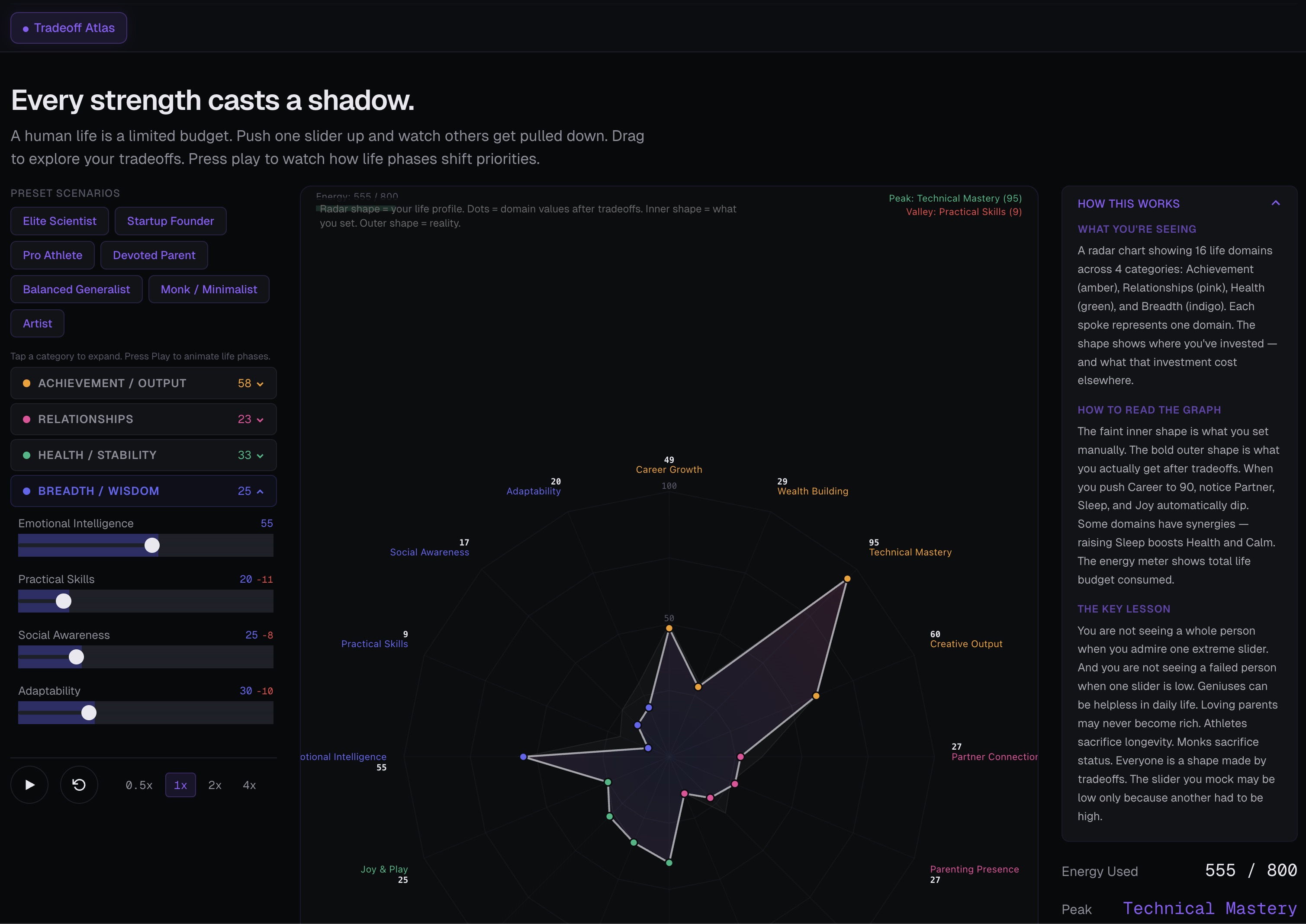
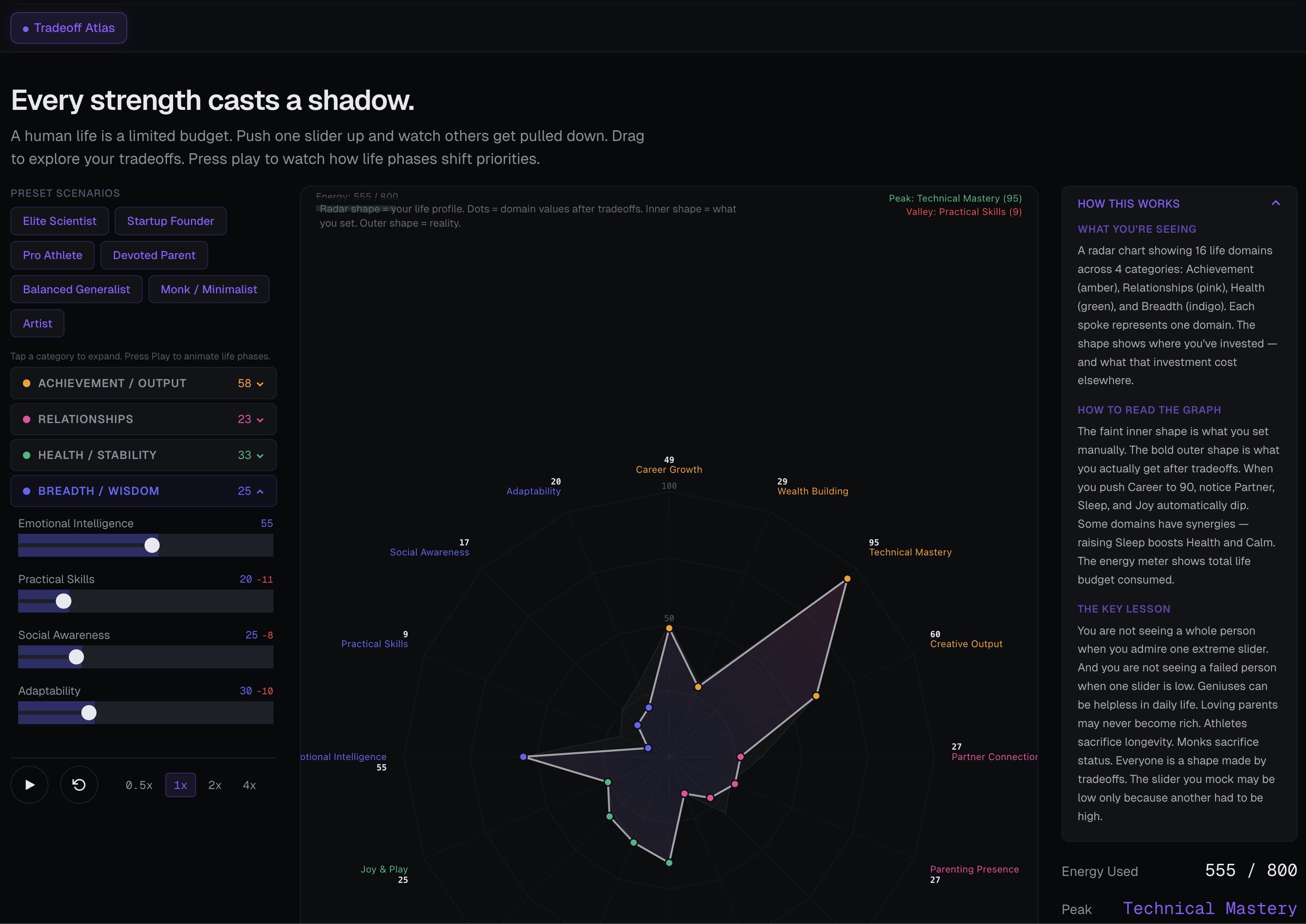
A human life is a limited budget. Push one slider up and others often get pulled down.
To make that tradeoff visible, I built an interactive illustration called **The Tradeoff Atlas**:
**Every strength casts a shadow.**
A human life is a limited budget. Push one slider up and watch others get pulled down. Drag to explore your tradeoffs. Press play to watch how life phases shift priorities.
[https://secondorder-469bce2c03ac.herokuapp.com/simulations/tradeoff-atlas](https://secondorder-469bce2c03ac.herokuapp.com/simulations/tradeoff-atlas)
That visual is not saying every life must be tragic or zero-sum. It is showing something more honest: human development is usually a pattern of allocation. Time goes here, so it cannot fully go there. Obsession sharpens one dimension while others stay dull. Sacrifice is not always visible from the outside, but it is almost always there.
Push **career intensity** high enough, and family presence may drop.
Push **athletic mastery** high enough, and breadth, rest, or longevity may suffer.
Push **business scaling** hard enough, and friendship, peace, and sleep may erode.
Push **devoted parenting** high enough, and status, wealth, or personal freedom may flatten.
Not always. Not perfectly. But often enough that the pattern matters.
This is why other people’s lives are so hard to judge from the outside. You may be admiring their mountain without seeing the valleys that paid for it.
The billionaire mountain may hide a divorce valley.
The athlete mountain may hide a normal-life valley.
The academic mountain may hide an emotional-attunement valley.
The devoted-parent mountain may hide a public-recognition valley.
The point is not cynicism. The point is realism.
Why opposite people often work so well together
Once you accept that every person has blind spots, a new question appears:
How do you reduce the danger of your own?
One answer is self-awareness. Another is experience. Another is humility.
But one of the strongest answers is **pairing with someone whose strengths are arranged differently than yours**.
This is why opposites can work so well together.
Not fake opposites. Not chaos plus chaos. Not incompatibility pretending to be chemistry.
Real complementary opposites.
The fast actor paired with the cautious thinker.
The visionary paired with the realist.
The emotionally sensitive person paired with the blunt truth-teller.
The structured planner paired with the adaptable improviser.
These pairings often create friction, but they also create coverage.
The thing that annoys you about the other person is often the same thing that protects you.
The cautious person slows down your impulsive mistakes.
The visionary prevents the cautious person from living too small.
The emotionally attuned person notices damage before it spreads.
The blunt person says the hard thing everyone else avoids.
The planner builds reliability.
The improviser keeps the system from becoming rigid and dead.
A good opposite does not erase your strengths. They help keep your strengths from becoming distortions.
Why this is technically true
This is not just poetic. It is practical.
Every person is a biased system.
Your strengths and weaknesses usually come from the same pattern. The thing that makes you effective in one context often makes you blind in another.
The fast decision-maker creates momentum but misses details.
The deep thinker catches flaws but can stall action.
The optimistic builder generates possibility but underestimates downside.
The skeptic prevents disaster but may kill good ideas too early.
The highly empathetic person preserves relationships but may avoid confrontation.
The blunt person cuts through nonsense but may damage trust.
So self-correction has limits. You can improve, but because your own mind is tuned a certain way, there are classes of error you are naturally less likely to catch.
That is why complementary people matter.
When two people have different biases, they catch different failure modes. They do not see the same board from the same angle. In systems terms, they increase perspective diversity and reduce blind-spot risk.
That is useful in marriage, business, parenting, creative work, leadership, and friendship.
A strong partnership is not just emotional support.
It is distributed perception.
But only if there is respect
Here is the catch.
Difference only becomes strength if both people respect what the other sees.
Without respect, complementary differences turn into contempt.
The realist calls the visionary naive.
The visionary calls the realist negative.
The emotional person calls the blunt person cold.
The blunt person calls the emotional person weak.
The planner calls the improviser irresponsible.
The improviser calls the planner controlling.
Once that happens, the system breaks.
The correction signal is still there, but nobody listens to it.
That is why productive partnership requires humility. You have to admit that the thing frustrating you may be the very thing saving you from yourself.
That is true in romance. It is true in business. It is true in teams. It is true in friendship.
The person you dismiss may understand a future problem you have not met yet
Life has a way of humiliating narrow definitions of intelligence.
The young person who dismisses parenting may later depend on parenting wisdom.
The ambitious person who ignores emotional skill may later watch relationships collapse.
The analytical person who mocks “soft” traits may eventually discover that grief, children, love, and trust do not yield to raw intellect.
The career-driven person may one day realize that success did not teach them how to be present.
The people we underestimate often seem unimpressive only because our life has not yet required what they know.
That is why arrogance is dangerous. It does not just make us rude. It makes us blind. It keeps us from learning from people whose strengths lie outside our current values.
And those people may be carrying the exact wisdom we will need later.
A better way to see people
A better framework is simple:
Everyone is wise somewhere.
Everyone is ignorant somewhere.
Everyone is shaped by tradeoffs.
Everyone has visible strengths and hidden deficits.
Everyone has some mountain and some valley.
So instead of asking, “Is this person smart or dumb?” a better question is:
**What terrain has this person had to master?**
What has their life forced them to learn?
What burden have they carried?
What skill did necessity build in them?
What kind of intelligence do they have that I do not naturally notice?
What am I missing because I only respect the skills I already understand?
Those questions are far more honest.
They leave room for real differences in talent and discipline without collapsing into cheap contempt.
The deepest point
Maybe the person society writes off as ordinary, unsuccessful, uneducated, or unimpressive is not the least valuable person at all.
Maybe they are the one who learned how to love.
How to stay patient.
How to endure.
How to create safety.
How to remain kind without becoming weak.
How to show up day after day in ways that do not make headlines but quietly hold the world together.
Those are not side skills.
Those may be closer to the center than we admit.
A civilization can celebrate brilliance and still rot from lovelessness.
A company can hire geniuses and still collapse from ego.
A family can have money and still fail where it matters most.
So yes, ignorance is universal.
But that truth is not depressing. It is clarifying.
It reminds us that no one sees the full board.
It reminds us that strengths have costs.
It reminds us that every life is an allocation problem.
It reminds us that complementary people are often more powerful than isolated talent.
It reminds us that humility is not weakness. It is accuracy.
Most of us are not meeting dumb people nearly as often as we think.
We are meeting partial people.
Which is exactly what we are too.