Dev log
The Bottleneck Is Us: Guiding the Next Wave of Intelligence
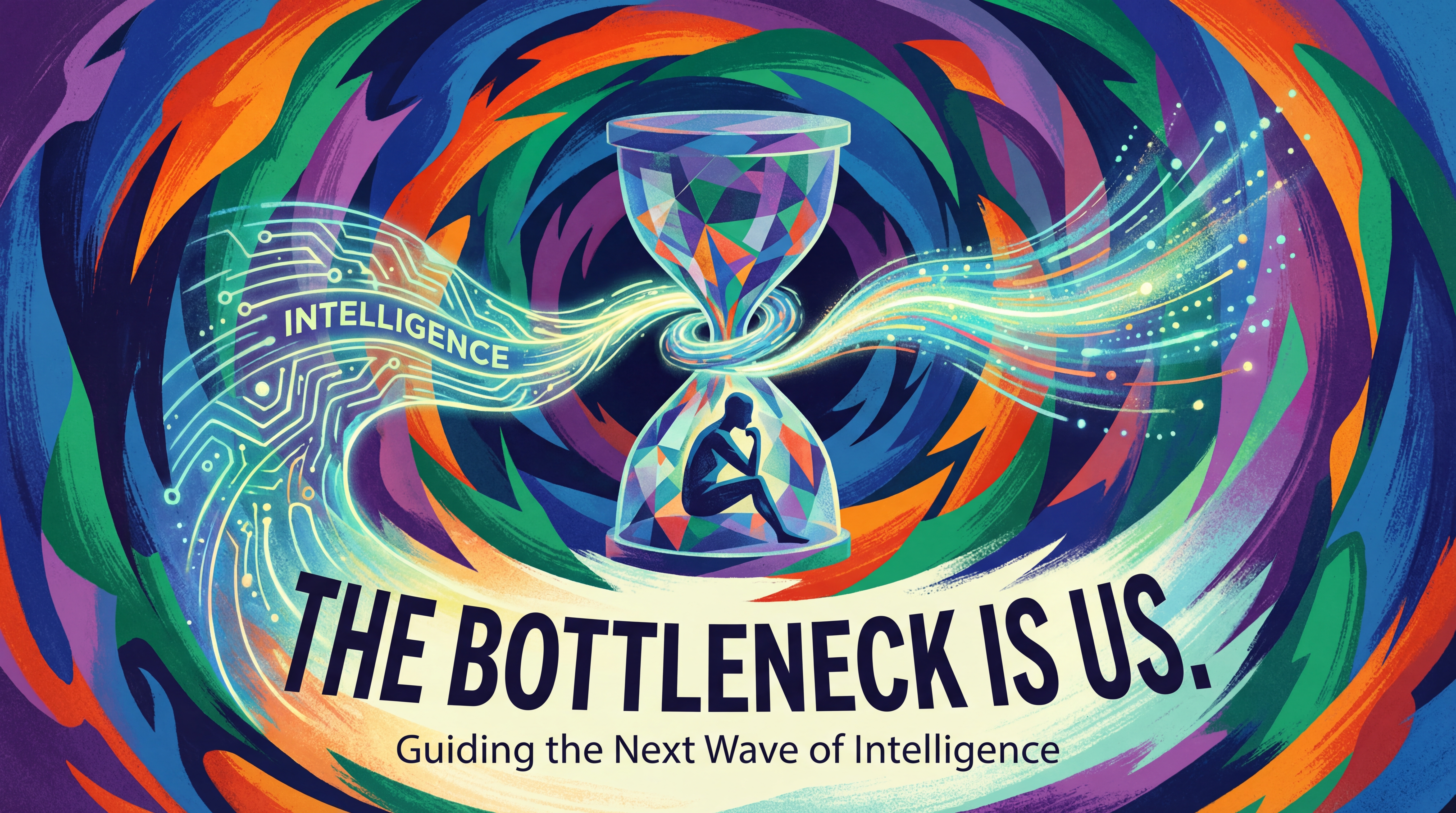
Every system in nature bends toward diminishing returns.
Push fertilizer into soil — crops increase, then plateau.
Add capital to a company — growth accelerates, then margins compress.
Add neurons to a brain — cognition improves, but energy cost rises.
The first inputs generate dramatic gains.
The later inputs cost more and deliver less.
This is not pessimism.
It is physics.
And now we are watching the largest scaling experiment in human history: artificial intelligence.
The curves look smooth.
The improvements look exponential.
The scaling laws feel inevitable.
But scaling laws do not repeal thermodynamics.
And they do not repeal economics.
If we are serious — technically and commercially — about the future of AI, we need to confront a harder truth:
**The limiting factor may not be the model.
It may be us.**
---
1. Scaling Laws Are Real — But They Are Not Infinite
Modern AI systems improve predictably as we scale:
* Parameters
* Data
* Compute
Performance follows power-law behavior. Larger models get better in measurable, stable ways.
This has led to a seductive belief:
> “Just scale it.”
But every additional increment of intelligence requires:
* More GPUs
* More electricity
* More cooling
* More capital
* More fabrication capacity
* More supply chain stability
The first 100 million parameters were cheap.
The first billion were manageable.
The first trillion required industrial-scale infrastructure.
And each next jump costs exponentially more capital and energy.
The math curve is smooth.
The physical world is not.
---
2. Intelligence vs. Integration
Even if we assume AI continues improving:
* It discovers new scientific insights.
* It designs materials.
* It writes legal frameworks.
* It generates pharmaceutical candidates.
* It optimizes supply chains.
* It proposes solutions to climate systems.
There is still a second curve.
The **integration curve.**
Human institutions move slowly:
* Regulation
* Validation
* Manufacturing
* Cultural adoption
* Capital allocation
* Ethical review
* Workforce retraining
If AI produces 10,000 breakthroughs per day, can we validate 10,000 per day?
If it designs 1,000 new molecules, can labs synthesize them fast enough?
If it suggests restructuring global logistics, can governments implement that without instability?
Intelligence may scale faster than civilization can metabolize it.
And when production exceeds absorption capacity, the marginal value of additional output decreases.
That is diminishing returns — not in capability, but in deployment.
---
3. The True Bottleneck: Human Throughput
We tend to assume AI is the limiting reagent in innovation.
For decades, it was.
Now the equation may be reversing.
The new constraint might be:
* Human attention
* Institutional capacity
* Physical infrastructure
* Energy supply
* Economic return thresholds
In business terms:
The ROI on additional intelligence depends on downstream conversion efficiency.
If your system generates more insights than your organization can implement, you don’t get exponential value.
You get backlog.
And backlog compounds friction.
---
4. Energy Is the Silent Constraint
All computation is energy transformation.
Data centers are not abstract clouds — they are:
* Land
* Concrete
* Rare earth metals
* Copper
* Silicon
* Transmission lines
* Water for cooling
* Power generation
We are pushing against planetary-scale energy systems.
Even with efficiency gains per FLOP, aggregate compute continues to rise.
If scaling continues indefinitely, one of three things must happen:
1. Energy production increases dramatically.
2. Compute becomes radically more efficient.
3. Economic appetite for further scaling declines.
Physics will collect its debt eventually.
---
5. The Business Reality: Marginal Value vs. Marginal Cost
Here is the business lens.
Suppose a new AI model costs $10B to train.
To justify that investment, it must:
* Unlock new markets.
* Increase productivity at scale.
* Replace large labor categories.
* Enable high-margin enterprise services.
If the marginal performance improvement over the previous model is small relative to cost, capital will slow.
Markets don’t scale because they can.
They scale because returns justify it.
If models become “good enough” for 90% of use cases, the incentive to spend 10x for 3% improvement weakens.
At that point, capital reorients from scaling intelligence to distributing it.
And distribution is where real economic transformation happens.
---
6. Waves, Not Infinity
History shows us something important.
Electricity did not scale in a straight line.
Railroads did not scale in a straight line.
The internet did not scale in a straight line.
They moved in waves:
* Breakthrough
* Overbuild
* Correction
* Integration
* Productivity surge
* Stabilization
* Next wave
AI will likely follow the same rhythm.
The danger is not scaling.
The danger is scaling without absorption.
When production exceeds societal capacity to integrate, instability follows.
That is where business leaders and technologists must act intentionally.
---
7. A Disciplined Scaling Framework
If we want to guide the waves, not react to them, we need a structured approach.
Phase 1: Scale
Push the frontier.
Expand capability.
Discover new behaviors.
Phase 2: Explore Limits
Stress-test the system.
Map failure cases.
Understand alignment boundaries.
Measure energy cost per incremental gain.
Phase 3: Extract Value
Deploy into:
* Enterprise workflows
* Education
* Healthcare
* Infrastructure
* Manufacturing
Focus on integration, not novelty.
Phase 4: Stabilize and Measure
Quantify:
* Productivity gains
* Economic shifts
* Labor displacement
* Energy consumption
* Societal impact
Then scale again.
Not blindly.
Strategically.
---
8. The Hidden Risk: Cultural Lag
Technology evolves faster than institutions.
If AI reshapes:
* Knowledge work
* Creativity
* Law
* Scientific discovery
* Personal identity
We must expect friction.
Humans derive meaning from contribution.
If contribution becomes optional for survival, society must redefine purpose.
That’s not a technical problem.
That’s a philosophical and economic one.
And ignoring it would be irresponsible.
---
9. Where the Bottleneck Moves Next
Suppose AI eventually automates research.
Suppose robotic labs accelerate validation.
Suppose supply chains are optimized algorithmically.
Then the bottleneck shifts again.
From humans…
To energy.
To materials.
To land.
To thermodynamic ceilings.
There is always a constraint.
The intelligent strategy is not to deny limits.
It is to identify the next one early.
---
10. The Strategic Position for Builders and Executives
For founders, technologists, and capital allocators:
The opportunity is not just in building smarter models.
It is in building:
* Better integration layers
* Workflow bridges
* Human-AI collaboration systems
* Energy-efficient architectures
* Validation pipelines
* Institutional accelerators
If intelligence becomes abundant, scarcity shifts elsewhere.
Whoever understands the new scarcity wins.
Right now, that scarcity looks like:
* Implementation speed
* Trust
* Validation
* Energy
* Human adoption capacity
---
11. The Real Scaling Law
Here is the deeper scaling law:
> The rate of AI progress that matters is not how fast models improve — it is how fast society can productively absorb and deploy those improvements.
That is the governing equation.
We are not just training neural networks.
We are training civilization.
---
12. Guiding the Wave
The coming years will not be defined by whether AI scales.
It will scale.
The defining question is whether we scale responsibly with it.
Do we:
* Chase capability without integration?
* Burn capital without ROI?
* Expand compute without energy planning?
* Disrupt labor without transition strategy?
Or do we:
* Build in phases.
* Measure impact.
* Respect physical limits.
* Align incentives.
* Create human-centered augmentation instead of reckless replacement.
---
Closing Thesis
AI may continue improving for decades.
But intelligence does not exist in isolation.
It exists inside:
* Economic systems
* Energy systems
* Political systems
* Human psychology
* Physical reality
The real scaling challenge is not making models smarter.
It is making civilization adaptive enough to use that intelligence wisely.
The bottleneck is not the algorithm.
The bottleneck is integration.
And the leaders who recognize that — technically and commercially — will shape the next wave instead of being swept away by it.
---