Dev log
The Hidden Cost of Your Greatest Strengths
Most of us look for our weaknesses in the obvious places. We hunt for them in our failures, our embarrassments, our bad habits, and the parts of our lives that keep falling apart.
That is not a bad place to start. But it isn’t the deepest place.
If you want to truly understand your blind spots, you need to look in a counterintuitive direction: **study your strengths.**
This sounds backward until you understand a fundamental principle of human psychology: traits and strengths are not purely "good." They are useful tendencies. In the right dosage and the right context, they propel you forward. But in the wrong amount, or in the wrong environment, that exact same strength becomes a liability.
Your weakness is rarely the opposite of your strength. More often than not, it is your strength pushed too far, applied too rigidly, or used in a situation where it no longer fits.
---
Why This Idea is Scientifically Sound
Modern personality psychology doesn't treat human beings as simple collections of virtues and vices. Instead, it focuses on enduring traits, flexibility, and context.
Frameworks like the Big Five personality model consistently show that traits carrying massive benefits in one domain usually carry trade-offs in another. For example, **conscientiousness** is brilliant for achievement and reliability. But when that drive for control hardens into perfectionism, it becomes *overcontrol*—leading to cognitive inflexibility and distress.
We see the exact same pattern socially. **Resilience** is a highly valuable trait, but people who pride themselves on "handling everything" often end up carrying the weight of the world completely alone. They mistake isolation for strength.
To complicate matters, humans are notoriously bad judges of their own blind spots. Psychological research on self-assessment reveals that some of our traits are much easier for *others* to see than for us to recognize in ourselves.
Put this all together, and you arrive at a powerful rule: **Your greatest weakness may simply be the shadow cast by your greatest strength.**
---
The Shadow Side of Strengths: A Practical Map
Every strength solves one set of problems by accepting another set of costs. A sharp knife is useful precisely because it cuts, but that same property makes it dangerous. Human traits work the exact same way.
Here is how admired qualities can tip into predictable problems when overextended:
| The Admired Strength | The Shadow (When Overused) | The Cost |
| :--- | :--- | :--- |
| **Warmth & Care** | Poor boundaries | People-pleasing, inability to say no, exhaustion. |
| **Resilience** | Support avoidance | Carrying too much alone, normalizing unfair burdens. |
| **Discipline** | Rigidity | Harshness, lack of adaptability, intolerance for mess. |
| **Structure** | Coldness | People feel managed rather than understood. |
| **Scholarship** | Overthinking | Analysis paralysis, delayed action, rumination. |
| **Devotion** | Self-sacrifice | Self-erasure, forgetting you are allowed to matter. |
| **Stewardship** | Resistance to change | Refusing necessary adaptations to preserve the past. |
| **Community** | Conformity | Groupthink, making necessary dissent feel disloyal. |
| **Vitality** | Impulsiveness | Acting before reflecting, starting fast but fading. |
*Note: None of these trade-offs mean your strength is fake. They are simply warnings about imbalance.*
---
How to Actually Find Your Weakness
You won't find your true weakness by staring into a mirror and thinking harder. You find it by tracing the repeated, subtle costs of your absolute best qualities. Here is the process:
1. Name your admired strengths
Start with the traits people praise in you most often. Are you dependable? Tough? Generous? Smart? Disciplined? Funny? Calm? Passionate? Praise points straight at your identity, and identity is exactly where blind spots hide.
2. Ask what problem that strength solves
Every strength is an adaptation. Discipline solves chaos. Warmth solves distance. Resilience solves adversity. If you know what your strength protects against, you can see what it might overcorrect.
3. Ask what it looks like when overused
Do not ask, "What is the opposite of my discipline?" Ask, "What does my discipline look like when it is too strong for the situation?" (Answer: rigidity, control, self-punishment).
4. Study your repeated friction
Your weakness is hiding in your recurring life patterns, not your one-time failures. Look for sentences you catch yourself saying repeatedly:
* "I always end up doing too much."
* "I can never just relax."
* "I overthink and miss my chance."
* "People take advantage of my kindness."
5. Ask others what they experience
Because self-knowledge has limits, ask trusted people in your life a question that might sting a little: *"What is something good about me that sometimes becomes hard to deal with?"* If the answer makes you slightly uncomfortable, you are on the right track.
---
The Mismatch: Examples from Real Life
The weakness is not the trait itself; it is the mismatch between the trait and the context. The healthiest people aren't those with the "best" fixed traits, but those with the **psychological flexibility** to adjust their traits to fit the moment.
> **The Disciplined Builder**
> He is respected because he shows up every day, keeps promises, and finishes hard things.
> *His shadow:* He cannot adapt when the plan breaks. He gets irritated by spontaneity and quietly judges people whose lives are messier than his. His weakness isn't a lack of discipline; it's discipline that cannot bend.
> **The Warm Connector**
> She makes everyone feel seen. She remembers birthdays, smooths tension, and keeps relationships alive.
> *Her shadow:* She absorbs too much. She feels guilty saying no and confuses closeness with unlimited access. Other people’s needs spill straight into her nervous system.
> **The Scholar**
> She sees complexity other people miss and can explain systems and implications with incredible precision.
> *Her shadow:* She becomes trapped in loops of thought, confusing deep analysis with actual forward movement. Cognition outruns action.
---
What to Do Once You Find the Weakness
Awareness is not enough. Plenty of highly intelligent people can describe their flaws beautifully while continuing to live inside them forever. Once you identify your shadow, take these three steps:
**1. Keep the strength, reduce the excess.**
Do not overcorrect. A warm person shouldn't become cold; a disciplined person shouldn't become sloppy. The goal is calibration, not reversal.
**2. Build the counter-skill.**
Every strength shadow has a specific antidote. Warmth needs boundaries. Resilience needs support. Discipline needs flexibility. Scholarship needs action.
**3. Track the trigger, not just the trait.**
Weaknesses are often situational. Maybe your warmth only turns into boundary failure with your family. Maybe your discipline only turns into rigidity under high stress. Watch the situations where the shadow appears.
---
A Thought Experiment: Visualize Your Trade-offs
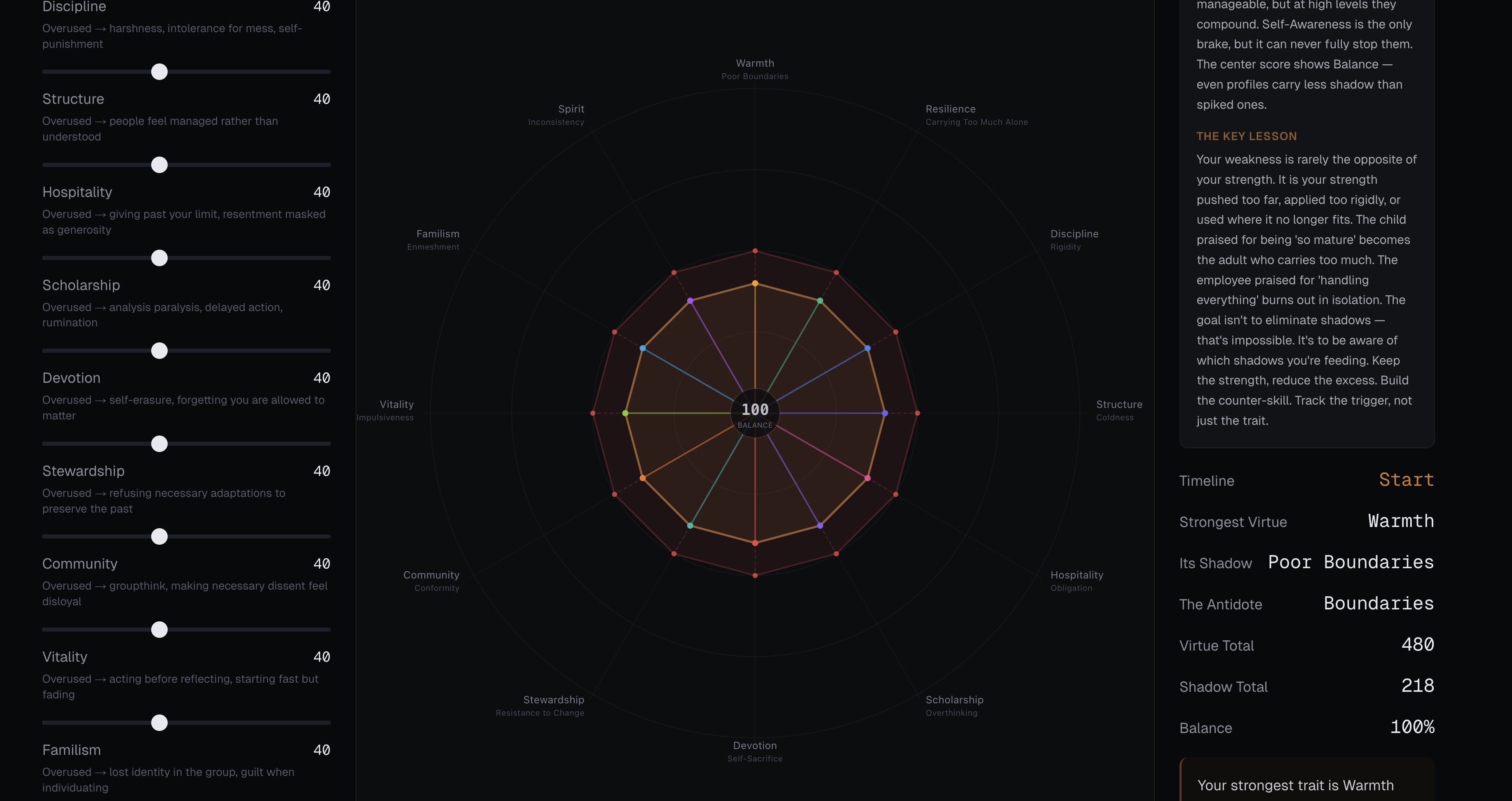
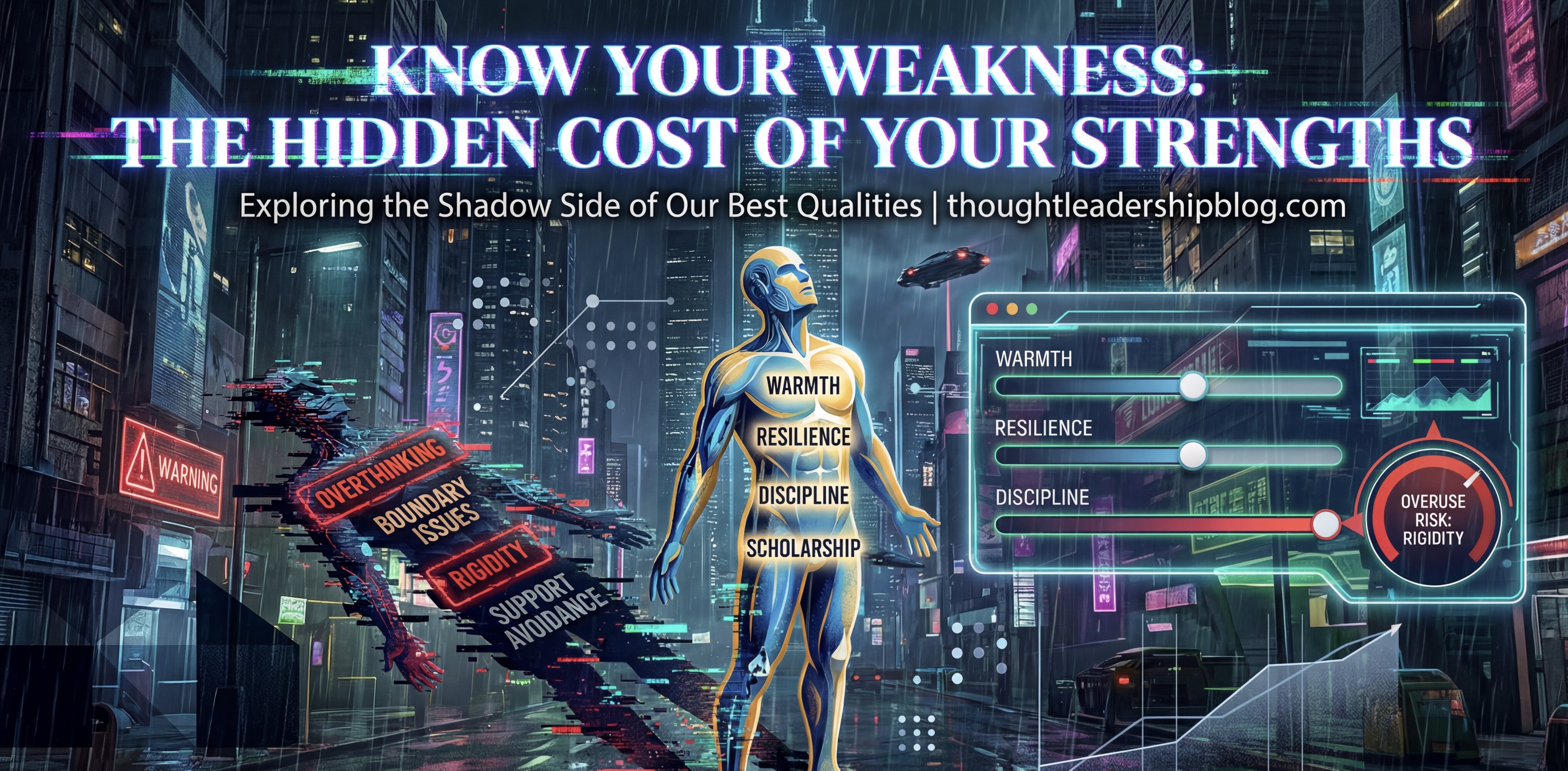
Imagine a digital dashboard with sliders for all of your best qualities.
If you push the **Warmth** slider all the way up to 10, watch a secondary meter called *Boundary Risk* rise with it. If you push **Resilience** to the max, watch *Support Avoidance* spike. Push **Community** up, and watch *Conformity Pressure* increase.
Now, add a second layer to your dashboard: **Context**.
That high "Discipline" slider might be perfect in the *Work* context, but if you keep it at a 10 in the *Romance* or *Family* context, the system crashes.
A trait is not a problem everywhere. It becomes a problem under certain demands, with certain people, or beyond a certain dosage.
Final Thought
A lot of popular advice tells you to "find your strengths," as if your strengths alone will save you. That is incomplete. Your strength can build your life, but it can also quietly distort it.
The most dangerous weakness is often the one you are immensely proud of. The child praised for being "so mature" becomes the adult who carries too much. The employee praised for "handling everything" becomes the leader who burns out in isolation.
To know your weakness, stop looking only where you are weak. Look where you are strong. Look at what has helped you survive, succeed, and build.
Then ask the uncomfortable question: **What does this become when I use too much of it?**
That is where your true weakness lives. Not in the absence of strength, but in strength without balance.
Interactive visualizer helpler : https://secondorder-469bce2c03ac.herokuapp.com/simulations/virtue-shadow