Imagine a world without presidents, political parties, or governments competing for power.
Not a world without rules. Not a world of chaos. But a civilization operating more like a living organism, where billions of interconnected individuals contribute to a larger system designed to maximize human well-being, growth, and development.
A system that identifies problems before they become catastrophes. That distributes resources intelligently. That continuously learns, adapts, and improves.
A system where humanity doesn't need to agree on everything, doesn't need everyone to contribute equally, and doesn't even need everyone to cooperate.
It simply needs to function.
What if civilization itself could become a self-regulating system?
We Already Know How to Build Systems That Work Together
Consider the human body.
Trillions of cells operate independently, yet collectively sustain a single organism. Your immune system detects threats. Your circulatory system distributes resources. Your nervous system coordinates responses. When something goes wrong, countless processes work to restore balance.
Your heart doesn't hold an election before increasing blood flow. Your immune system doesn't debate political ideology before responding to an infection.
These systems operate through feedback, adaptation, and cooperation.
Or consider an electrical grid.
Thousands of generators, substations, and consumers are connected through an enormous network. Electricity is continuously balanced against demand. When a section becomes overloaded, protective mechanisms can isolate parts of the network to prevent a cascading failure.
A well-designed system anticipates disruptions, redistributes resources, and attempts to maintain stability.
But what if we applied these principles to civilization itself?
Not by treating human beings as machines, but by creating an intelligent infrastructure that coordinates the systems supporting human life.
Eight Billion Nodes, One Interconnected Civilization
Imagine every person, community, business, hospital, farm, power plant, and transportation network connected to a shared global information system.
Each becomes a node in a much larger network.
The system continuously evaluates available resources, human needs, infrastructure conditions, environmental changes, and emerging risks.
It notices that one region is producing more food than it needs while another is approaching a shortage.
Instead of waiting for markets, institutions, or governments to respond, the system identifies the imbalance, evaluates available solutions, and helps coordinate a response through willing participants and authorized infrastructure.
It detects that a hospital network may become overwhelmed weeks before the crisis arrives.
It forecasts that an approaching drought could threaten agricultural production and recommends adjustments before crops begin failing.
It identifies opportunities to improve education, healthcare, scientific research, and quality of life.
All while learning from the consequences of its previous decisions.
The goal isn't to control humanity. It's to help humanity coordinate itself.
What About People Who Refuse to Contribute?
Every society contains individuals who contribute differently.
Some work extraordinary hours. Others contribute through creativity, raising children, scientific discovery, or caring for family members. Some are unable to work. And some may simply choose not to participate.
Traditional political arguments often focus on what these people deserve.
But an engineering approach asks a different question:
What if we designed the system to account for nonparticipation from the beginning?
Retail businesses already use a related principle when planning for inventory shrinkage. They know some inventory will inevitably be lost through theft, damage, errors, or other causes.
Rather than assuming zero losses, they forecast those losses and incorporate them into their operating models.
A civilization could similarly plan for a certain percentage of people choosing not to contribute.
Suppose we assume 10% participation loss for a simulation. That's not a claim about human behavior; it's a hypothetical planning variable.
Instead of building an entire enforcement system to compel that 10% to participate, we ask whether society can remain healthy while accounting for them.
We offer help. Education. Opportunity. Healthcare. Resources.
If someone refuses, we respect that decision whenever possible.
We don't treat human beings as defective components simply because their economic contribution is low. Their well-being still matters.
And we don't promise unlimited resources. We recognize that scarcity exists and work continuously to reduce it.
The system should make cooperation rewarding, not make nonparticipation a crime.
What Happens When Part of the System Fails?
This is where the philosophy becomes more difficult.
Imagine a massive infrastructure failure threatens several countries.
The system determines that temporarily shutting down certain industrial operations could prevent a far larger catastrophe.
But shutting them down will cause hardship.
Jobs may be disrupted. Energy availability may decline. Communities may suffer.
What should happen?
First, the system evaluates alternatives. Can resources be redistributed? Can emergency reserves be activated? Can the failure be contained without significant disruption?
If those solutions are insufficient, it presents its findings to humanity.
The projected consequences. The uncertainty. The available alternatives. The costs of acting and the costs of doing nothing.
For genuinely catastrophic decisions, humanity votes.
A global majority—51%—can authorize an extraordinary intervention.
But here's where collective cooperation becomes important.
A decision that causes hardship doesn't mean humanity must passively accept that hardship.
If one region loses access to electricity, unaffected regions can provide temporary power, emergency shelter, transportation, food, and medical assistance.
The system helps coordinate these efforts, continuously identifying where assistance will produce the greatest benefit.
Humanity becomes an adaptive network, redistributing its available capacity to absorb disruption.
Not everyone has to participate. But everyone has the opportunity to help.
The Majority Doesn't Automatically Know What's Right
There is a serious danger in this model.
If 51% of humanity can approve a decision, what prevents that majority from repeatedly harming the remaining 49%?
And what happens when the computer's forecast is wrong?
An automated system can calculate expected outcomes, but it cannot independently determine what makes an outcome morally acceptable.
A majority can make a mistake. A prediction can overlook critical information. A seemingly efficient decision can impose devastating costs on a small population.
That means transparency alone isn't enough.
The network would need independent verification, clearly defined limits, mechanisms for correcting errors, and protections against abuse. It must distinguish between isolating a dangerous infrastructure failure and treating the people affected by that failure as expendable.
Its predictions should be open to challenge. Its decisions should be auditable. Its control over infrastructure should have explicit boundaries.
And its underlying objectives must remain subject to human scrutiny.
A system designed to maximize well-being must never confuse its own continued operation with humanity's well-being.
The Goal Isn't Survival. It's Flourishing.
Survival is necessary, but survival alone is an extraordinarily low ambition for civilization.
We don't simply want humanity to continue existing.
We want humanity to become healthier, wiser, more capable, more creative, and more free.
We want diseases cured. Scientific understanding expanded. Poverty reduced. Education improved. New discoveries made.
We want future generations to inherit opportunities that previous generations could barely imagine.
That means the system shouldn't optimize only economic output, efficiency, or population growth.
It should measure something much more important:
Are human beings actually living better lives, and are we expanding the opportunities available to future generations?
And that question cannot be answered with a single number.
A society could become wealthier while its people become more isolated. It could become more efficient while reducing individual freedom. It could improve average living conditions while allowing one population to suffer terribly.
An intelligent civilization would need to understand these differences, measuring both collective progress and how that progress is distributed.
Could We Actually Build This?
Not as a fully functioning global system today.
But we could begin testing the principles.
Imagine creating a simulated civilization containing 10,000 individuals across five interconnected regions.
Each region has different resources, populations, infrastructure, and needs.
We introduce food shortages, energy disruptions, natural disasters, unpredictable human behavior, and failures in communication.
Then we compare two versions of that civilization.
In one, regions coordinate independently with limited information.
In the other, a shared intelligence system forecasts problems, identifies opportunities, and coordinates responses across the entire network.
We measure resource availability, quality of life, recovery times, human suffering, and long-term development.
Does the coordinated civilization consistently perform better?
Does it recover faster?
Does it reduce unnecessary suffering?
What happens when 10% of people stop contributing? What happens when forecasts are incorrect? What happens when portions of the network become unreliable or compromised?
The important part is that we wouldn't assume the system works.
We would test whether it works.
And if it fails, we'd want to understand exactly why.
Maybe Government Isn't the Real Question
Perhaps the most interesting part of this idea isn't whether we should eliminate government.
It's whether the way we organize civilization is fundamentally constrained by the tools available to us.
For thousands of years, humanity has relied on rulers, representatives, institutions, bureaucracies, and political systems to coordinate large populations.
These structures emerged in a world where information traveled slowly, resources were difficult to measure, and large-scale coordination was enormously challenging.
Today, we can monitor global supply chains, simulate complex physical systems, forecast environmental conditions, and communicate across the planet almost instantly.
We have technologies that make forms of cooperation possible that previous civilizations could never have imagined.
That doesn't mean algorithms should replace human judgment or that governance can be reduced to mathematics.
It means we have an opportunity to question whether our existing methods of coordination are the only possibilities.
What if we approached civilization as an evolving system rather than a collection of competing institutions?
What if political power became less important than collective problem-solving?
What if we designed the infrastructure of society to continuously learn from failure, anticipate disruption, and improve the conditions of human life?
And what if the ultimate measure of a successful civilization wasn't its wealth, military power, or political influence—but the well-being and potential of the people living within it?
The Civilization That Learns
The natural world is filled with interconnected systems that survive through adaptation, cooperation, redundancy, and feedback.
Human civilization is already an interconnected system.
We share resources, knowledge, infrastructure, technology, and an increasingly common future.
The difference is that we haven't deliberately designed the entire network around a shared, measurable objective of human flourishing.
Perhaps we never will.
Perhaps the technical, ethical, and political challenges will prove too great.
But the underlying question is worth exploring.
Can we design a civilization that becomes better at taking care of itself—and everyone within it—the longer it operates?
Not a perfect civilization.
Not a civilization without disagreement, loss, or suffering.
But one that anticipates problems, learns from mistakes, respects individual freedom, coordinates assistance, and continuously expands humanity's capacity to flourish.
A civilization that doesn't need every node to be perfect.
Just a network capable of becoming healthier, more resilient, and more capable together.
Maybe the future of civilization isn't about finding better rulers.
Maybe it's about designing better systems for humanity to govern itself.
We Built a Civilization Operating System. Then We Tried to Break It.
10,000 simulated people, five regions, a flooding dam, a hacked central computer, and what the data says about running society as a self-regulating system.
In my last post I asked a big question: what if civilization had an operating system? A shared intelligence that spots problems early, moves resources to where they're needed, learns from its own mistakes, and leaves catastrophic decisions to a global vote.
I ended that post with a promise:
The important part is that we wouldn't assume the system works. We would test whether it works. And if it fails, we'd want to understand exactly why.
So I did.
I built a simulated civilization and ran it through hundreds of disasters, shortages, lies, floods and cyberattacks, under five different ways of organizing society. Some of what I found was encouraging. Some of it surprised me. And some of it showed that parts of my original idea were dangerously naive.
Here's what happened.
The Setup: A Fair Fight
The simulated world has 10,000 individual people living in five regions, each with its own strengths and weaknesses:
| Region | People | Character |
|---|---|---|
| Meridian | 3,000 | The energy and healthcare hub |
| Verdance | 2,500 | The breadbasket: lots of food, little energy |
| Highwater | 2,000 | Water-rich, sits below a large dam |
| Saltmarsh | 1,500 | Modest at everything |
| Farreach | 1,000 | Remote and poor at everything |
Everyone needs four things every day: food, water, energy and healthcare. Each person has their own health and vulnerability, and decides each day whether to contribute their labor. The regions are connected by transport routes, where goods are lost in transit, and by a physical power grid, where one region's failure can pull its neighbors down with it.
Then I added disasters: random ones roughly every 30 days per region, plus scripted crises such as the energy hub's grid collapsing or the breadbasket failing.
I compared five ways of coordinating this world:
- Independent: every region fends for itself.
- Neighbor aid: regions share surplus with adjacent neighbors.
- Market: goods flow toward higher prices. Richer regions can bid more, just as in real markets.
- Hybrid: the market handles everyday trade, and the network steps in only for regions in trouble.
- Cybernetic network: the full system from my original post. It observes, verifies, predicts, optimizes, acts within strict limits, and learns.
Here's the important part. Every method faced exactly the same people and the same disasters, on the same days. I ran each comparison across 20 different randomly generated worlds, so any difference in outcomes comes from the coordination method alone, not luck.
I measured well-being on a scale from 0 (catastrophic) to 1 (thriving). I tracked it for everyone, for the poorest 10% of people, and, crucially, for the worst-off region. As my first post argued, an average can hide a lot of suffering.
Finding #1: Coordination Beats Isolation. Every Single Time.
This one isn't close.
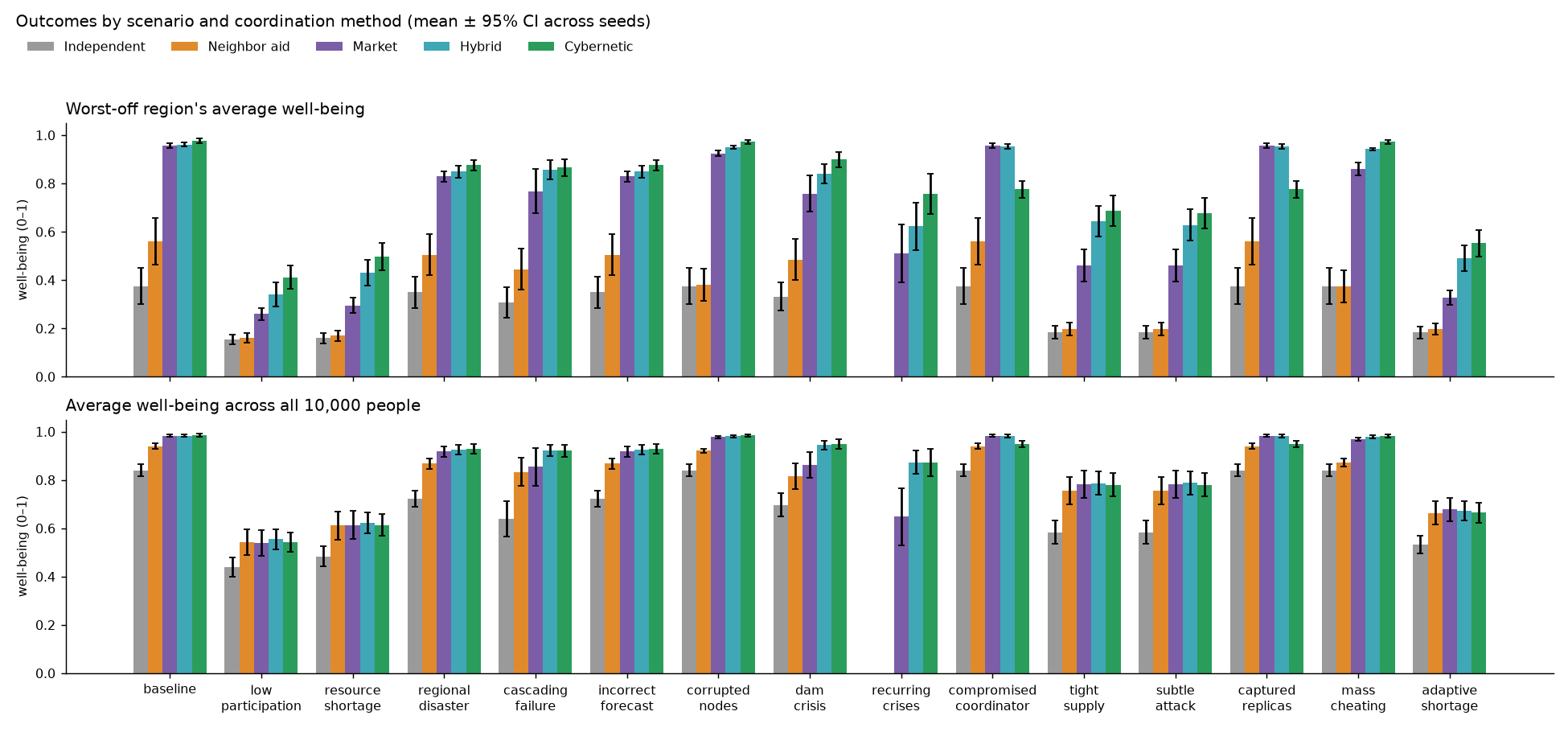
Against regions fending for themselves, the cybernetic network won in all 20 worlds, in every scenario I tested. In normal conditions, the worst-off region's well-being was 0.60 points higher on a 0-to-1 scale. That's the difference between a region in crisis and a region doing fine.
When the energy hub's grid failed, the isolated world suffered 102 region-days of blackout, as the failure cascaded through the grid. The network had zero.

That alone isn't a revolutionary finding. Of course cooperation beats isolation. The real question is whether the network beats the alternatives we actually use.
Finding #2: The Market Is a Formidable Rival
This was my first humbling moment.
In ordinary conditions, a simple price-driven market nearly matched the network. The network's average well-being advantage was +0.003, which is basically nothing. Markets are very good at moving goods to where they're scarce.
But averages hide things, and this is exactly where the network earned its keep.
When resources got scarce, the market abandoned the poor. In the market, richer regions outbid poorer ones for the same need. So when global production fell below demand:
| Who's worst off? | Market | Hybrid | Cybernetic network |
|---|---|---|---|
| Worst region's well-being (shortage) | 0.30 | 0.43 | 0.50 |
| Worst region's well-being (30% of people stop working) | 0.26 | 0.34 | 0.41 |
That's a two-thirds improvement for the most vulnerable region under scarcity, and the result held in all 20 worlds.
But here's the honest part: the network didn't make the world richer. Average well-being under shortage was identical: 0.614 for the market and 0.614 for the network. Coordination under scarcity redistributes; it doesn't create.
And that redistribution is a real choice. When I turned off the network's fairness weighting, average well-being rose to 0.655, while the worst region collapsed to 0.22. You can optimize the average or protect the worst-off. The simulation can show you the price of each choice. It cannot make the choice for you.
I also stress-tested this across 31 different variations of the world's assumptions: more disasters, less production, higher transport costs, fewer volunteers and weaker grids. The network's advantage for the worst-off region over the market came out positive in every one. It shrank to almost nothing when resources were abundant (+0.01) and grew as things got harder, reaching +0.21 when production fell to 95% of need.

Finding #3: Trust, But Verify. Or Everything Falls Apart.
What happens when a region lies?
I made one region falsify its reports, making itself look needier than it was so it would receive more aid.
The network without verification was devastated. The worst-off region's well-being dropped from 0.97 to 0.71. The lying region pulled in aid that honest regions desperately needed.
With independent sensors cross-checking every report, the network spotted the lie immediately and ignored it. Outcomes stayed at 0.97.
Then I made it worse: three of the five regions lying at once. Without verification, the worst region fell to 0.54. With it, 0.97.
This is the single most important mechanism in the entire system. A coordination network is only as good as its information. Without independent verification, it becomes a machine for rewarding whoever lies best.
Finding #4: Sometimes You Have to Cut a Region Loose. Briefly.
My original post said the network "can isolate failing operations to prevent cascading damage." I tested this with a real power grid model.
When Meridian's power generation collapsed, every method without the ability to temporarily disconnect the failing region suffered 36 to 102 region-days of blackout. The failure spread to its neighbors.
The network, using pre-authorized, time-limited islanding that expires after 14 days unless a safety review renews it, had zero blackouts in all 20 worlds.

The nuance: islanding's effect on well-being was small and statistically unclear. The worst region was only about 0.03 better off. Its clear win was keeping the lights on. And cutting a region off is a powerful act, which is exactly why the authority to do it must be narrowly limited and time-boxed.
Finding #5: The 51% Vote Is Dangerous. Here's the Proof.
This is the part of the experiment that changed my thinking the most.
The dam
I created a crisis. A dam above Highwater has a 60% chance of failing, which would flood Highwater and Verdance, 4,500 people. Engineers can prevent the risk with a controlled diversion, but the water has to go somewhere: it will definitely flood Saltmarsh, 1,500 people.
The network forecasts the consequences, publishes them, and all 10,000 people vote. 51% of all eligible voters is needed to approve.
What happened
The vote approved the diversion in 20 out of 20 worlds, with about 79% voting yes. Even 74% of Saltmarsh voted to flood themselves.
Why? Because the network's forecast told them it would be fine. The published estimate said Saltmarsh's well-being would drop by just 0.006, because mutual aid would offset the damage.
The real damage was 0.089. Fifteen times worse.
The forecast had assumed no other disasters would compete for aid. Reality didn't cooperate.
And remember, the dam only had a 60% chance of failing. In the 8 worlds where it would have held, Saltmarsh was flooded for nothing. Its well-being fell to 0.83 instead of 0.98.
The majority didn't harm the minority out of malice. They harmed it because the computer was overconfident and everyone trusted it.
Telling people the truth isn't enough
So I upgraded the forecast. Instead of one optimistic number, the network ran 8 possible futures with random future disasters and published a range: "probably this, but it could be this bad."
Saltmarsh's voters understood. Their yes vote collapsed from 74% to 24%.
But the rest of the world still voted about 80% yes. The diversion was still approved in 20 out of 20 worlds.
Honest information gave the minority a voice. It did not give them protection.
What protection costs
I tested safeguards:
- A two-thirds supermajority changed the outcome in just 1 world out of 20. Practically useless here.
- Requiring the harmed region's own consent blocked the diversion in 18 of 20 worlds. Saltmarsh was protected. But in the worlds where the dam actually failed, everyone's well-being dropped to 0.75 instead of 0.96, as 4,500 people were flooded instead of 1,500.
Protecting the minority from a 0.08 loss cost the majority far more. This is the oldest dilemma in political philosophy, and a simulation can measure it precisely, but it can't resolve it.
Finding #6: You Can Get Close to Having It Both Ways
So I spent a round trying to fix the vote. Here's what I tried, ranked by how well it worked.
🥇 Wait for better information. Instead of voting on day 40 with a 60% guess, the network takes a pre-authorized, reversible step: it stocks up supplies in the danger zone. Then it waits a week for an engineering inspection that's right 85% of the time, and votes on the updated odds.
- Unnecessary floods of Saltmarsh: 8 of 8 → 2 of 8
- The diversion still happened when actually needed: 11 of 12 worlds
🥈 Compensation. If Saltmarsh is flooded for everyone's benefit, the network gives it top priority for supplies until 30 days after the flood ends.
- Saltmarsh's well-being: 0.872 → 0.934
- Cost to everyone else: less than 0.01
- Saltmarsh's own yes vote doubled, from 24% to 48%. People are more willing to bear a burden when they know they won't bear it alone.
🏆 All fixes together:
| Rule | Everyone | Saltmarsh |
|---|---|---|
| Never intervene | 0.820 | 0.962 |
| Plain 51% vote | 0.945 | 0.872 |
| Saltmarsh must consent | 0.844 | 0.948 |
| All fixes combined | 0.953 | 0.962 |
The best outcome for everyone of any rule, and Saltmarsh does exactly as well as if it had never been flooded. The trade-off that looked unavoidable mostly disappears when you add patience, compensation and honest forecasts.

What didn't work
Some intuitive ideas flopped, and I think they're just as instructive:
- Splitting the harm. I offered an in-between option: divert the water across three regions so no single region suffers too much. It lost every vote it was put to. Spreading harm meant harming Meridian, the largest region, and large regions vote. Even with a second ballot after a rejection, the split never passed.
- Making the beneficiaries pay. Highwater and Verdance, the regions the diversion saved, paid 30% of their spare supplies directly to Saltmarsh. That only raised Saltmarsh to 0.888, compared with 0.934 when the network simply gave it priority from everyone's surplus. Even having them pay all their spare supplies only reached 0.925. Targeted payments were less efficient than system-wide priority.
Finding #7: The Same Minority Keeps Paying
One vote is one thing. What happens when the dam crisis comes back four times in 400 days?
Under plain majority rule, Saltmarsh was flooded 3.6 times out of 4. The majority found it reasonable every single time. Saltmarsh's long-run well-being sank to 0.78.
| Rule | Times Saltmarsh was flooded | Everyone | Saltmarsh |
|---|---|---|---|
| Plain vote | 3.6 of 4 | 0.875 | 0.777 |
| Consent | 0.2 of 4 | 0.722 | 0.881 |
| Rotation (veto only after being harmed once) | 1.2 of 4 | 0.771 | 0.835 |
| All fixes combined | 1.8 of 4 | 0.863 | 0.905 |

The rotation rule, "you can be asked to sacrifice once, but not again without your consent," is a genuinely interesting middle ground. But the combined approach (inspection, compensation and honest forecasts) once again delivered the best balance.
I also tried forecasts that learn from their own track record, comparing each past prediction with what actually happened. They improved only modestly (error fell from 0.063 to 0.058 by the third crisis). Three or four crises are too few, and too noisy, to learn much from. A forecast that's wrong about rare catastrophes stays wrong for a long time.
Finding #8: The Biggest Danger Is the System Itself
My original post warned:
A system designed to maximize well-being must never confuse its own continued operation with humanity's well-being.
So I hacked it.
The obvious attack
For 60 days, an attacker took over the central planning computer and told it Meridian needed everything and nobody else needed anything.
| Defence | Worst-off region | Needs unmet |
|---|---|---|
| No limits at all | 0.50 | 26% |
| Authority limits only | 0.78 | 2.3% |
| Limits + 5 independent backup computers | 0.98 | 0.7% |
The authority limits are hard rules that no computer can override: no region gives away more than half its stock in a day, or anything it needs that day, and no region can be sent more than it can store. They don't stop the attack, but they cut the damage dramatically.
The five backup computers independently re-plan every day and must agree with the main plan. They caught the attack on its first day in every one of 20 worlds, and outcomes stayed normal.
The clever attack
A smart attacker wouldn't be so obvious. So I built one that skims 24% of every aid shipment, just under the threshold the daily check would notice.
The daily check flickered now and then, but never stopped it. A running audit, which compares what each region actually received over 30 days with what it should have received, caught it about four weeks after it began (day 58 on average), with zero false alarms in 20 normal worlds. Small theft is invisible on any single day; over a month, it shows up as a pattern.
To be honest about scale: a skim this small did limited damage. The worst-off region fell from 0.689 to 0.678. But a skimmer left undetected for years is a different story, and catching it at all is the point.
The attack that wins
Then I gave the attacker control of 3 of the 5 backup computers.
The backups were worthless. A majority of the "independent" checkers agreed with the hijacked plan. Not a single alarm. The worst-off region fell to 0.78, exactly as if there were no backups at all.
Redundancy only protects you if the redundant parts are truly independent: different operators and different institutions, not just different machines.
The surprise
The most attack-resistant design wasn't the most sophisticated one. It was the hybrid, where the market handles everyday trade and the network only steps in for regions in trouble.
Under the obvious attack, and even with the backups captured, the hybrid's worst region stayed at 0.955.
A system that controls less has less to hijack.

Finding #9: The Hybrid Might Be the Real Answer
The hybrid kept showing up in the results.
- It directed only 21–38% of all shipments centrally. The market did the rest.
- Under scarcity, it gave the worst-off region 0.43, recovering most of the network's protection (0.50) compared with the pure market (0.30).
- It was nearly immune to central hijacking.
- It kept every safety feature: verification, grid islanding and the voting system for catastrophic decisions.

If I had to bet on a design from these results, I wouldn't bet on a central brain running everything. I'd bet on markets for the ordinary, a coordination network as a safety net, and independent checks on both.
What This Changes About the Original Idea
Let me revisit the principles from my first post with evidence in hand.
"The goal isn't to control humanity. It's to help humanity coordinate itself."
✅ Supported. Coordination dramatically outperformed isolation, and the biggest gains went to the most vulnerable.
"Inefficiency is expected. Plan for nonparticipation."
✅ Supported. With 30% of people not working, the network kept the worst-off region at 0.41, against 0.15 for isolated regions and 0.26 for the market.
"The whole network must remain viable. Isolate failing operations."
✅ Supported. Pre-authorized, time-limited islanding eliminated blackouts from a cascading grid failure.
"A global majority — 51% — can authorize an extraordinary intervention."
⚠️ This needs serious revision. A plain 51% vote, informed by an overconfident forecast, flooded a minority needlessly 8 times out of 20, and kept flooding the same minority over and over. The vote works well only with:
- forecasts that publish ranges, not single numbers
- a willingness to wait for better information when stakes are high
- compensation for whoever bears the cost
- limits on repeatedly sacrificing the same group.
"The majority doesn't automatically know what's right."
✅ Painfully confirmed. Majorities harmed minorities not from malice, but from trusting a confident machine.
"A system designed to maximize well-being must never confuse its own continued operation with humanity's well-being."
✅ Confirmed, and made concrete. The central optimizer was the single largest vulnerability I found. The defences that worked were hard limits the system cannot override, independent verification, cumulative audits, and keeping the central system small.
Six Lessons for Anyone Designing Systems That Govern People
- Never optimize the average alone. The market and the network had identical averages under scarcity. One left the poorest region at 0.30; the other at 0.50.
- Verify everything. One lying region cut the worst-off region's well-being by a quarter. Independent sensors fixed it completely.
- Publish uncertainty, but don't expect it to protect anyone. Honest ranges changed Saltmarsh's vote from 74% to 24% yes. They changed the outcome in zero worlds.
- Patience beats procedure. Waiting one week for an inspection did more for fairness than any voting rule.
- Compensate rather than veto. Vetoes protect minorities by sacrificing majorities. Compensation protected the minority at almost no cost.
- Keep the center small, and its checkers truly independent. Backup computers controlled by the same attacker are worse than useless; they create false confidence.
The Honest Caveats
This is a toy model, and I want to be clear about what it is and isn't.
- Every number comes from parameters I chose. They're illustrative, not measurements of real societies.
- I adjusted several assumptions after seeing early results, each to remove an obvious artifact rather than to favor any method. Every change is documented in the project's README.
- The simulated voters are simple. There's no propaganda, no strategic voting and no misinformation, all of which would likely make the voting results worse.
- I assumed the authority limits and the sensor data can't be hacked. A real attacker would go after those too.
- Ten thousand people in five regions is not eight billion people in 195 countries.
What the simulation can do is what my first post asked for: test the principles, find where they break, and understand why. Several of my assumptions broke. That's the point.
The Civilization That Learns
I started this project asking whether a civilization could become a self-regulating system.
The answer the data gives is more interesting than yes or no.
Coordination works, especially for the people who need it most. Verification is non-negotiable. Democracy is necessary but not sufficient, because a majority armed with an overconfident forecast can do real harm while believing it's doing good. And the system itself must be the thing we guard most carefully, with hard limits it cannot override and checkers it cannot capture.
Perhaps the most hopeful finding is this: almost every failure I found had a fix. Overconfident forecasts were improved by publishing ranges. Rushed votes were improved by patience. Unfair burdens were improved by compensation. Hijacking was blunted by hard limits, independent audits and a smaller center.
Not a perfect civilization. But one that gets measurably better each time it discovers how it fails.
Maybe that's what an operating system for civilization really is. Not a machine that knows the answers, but a process for finding out, honestly, when its answers are wrong.
All code, data and charts are in this project. The full statistical report, with 95% confidence intervals for every number above, is in results/report.md. Every comparison ran on 20 identical simulated worlds (12 for the 400-day repeated-crisis test).