Dev log
What the Dot-Com Bubble Teaches Us About the AI Era
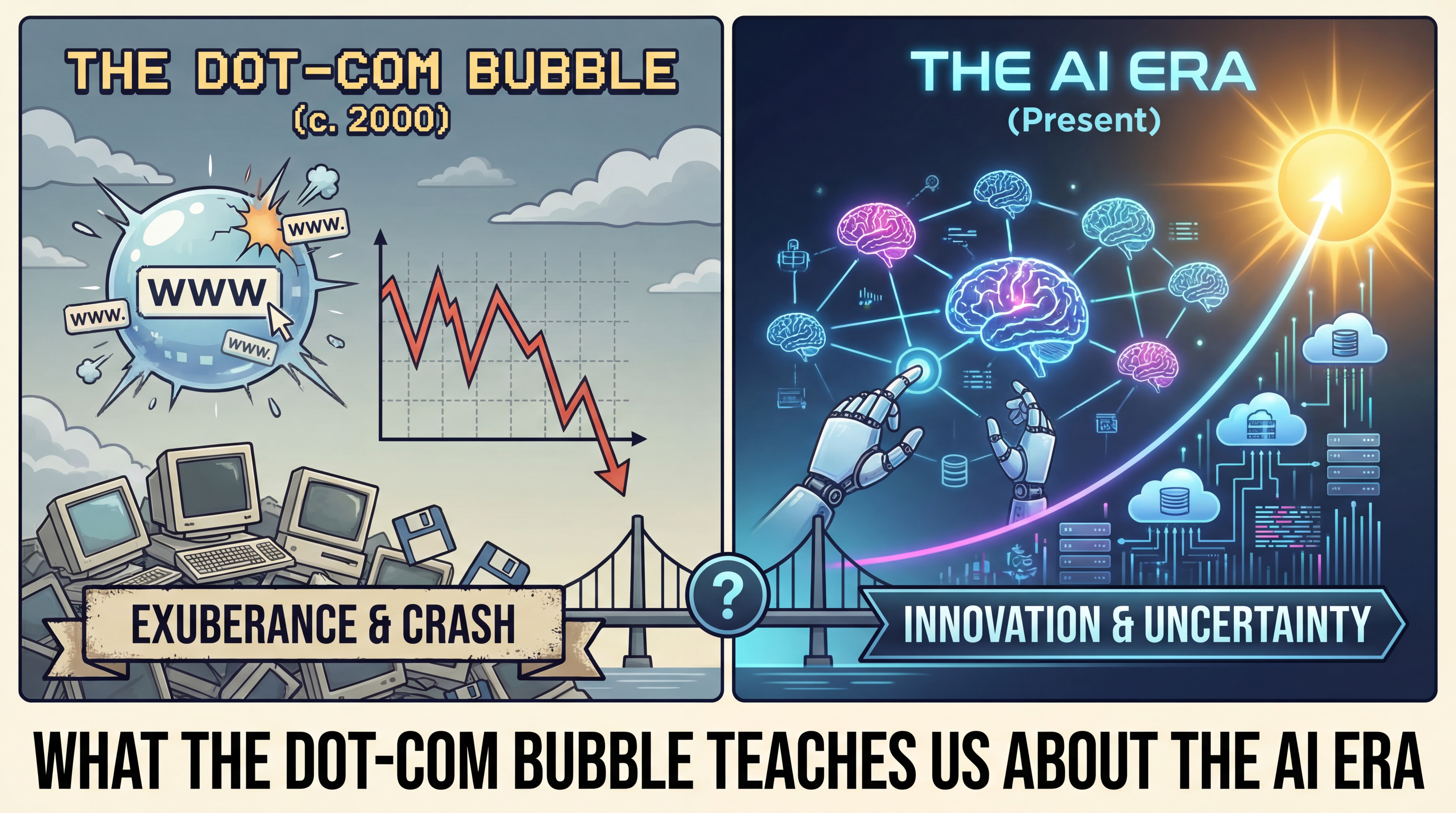
At the end of the 1990s, the internet felt like magic. New companies were launching every day, venture capital poured into anything with “.com” in its name, and stock prices soared even when businesses had no profits, no customers, and sometimes no real product.
Then, almost overnight, it all collapsed.
The dot-com bubble burst around the year 2000, wiping out trillions of dollars in market value and sending hundreds of companies into bankruptcy. Some of the most famous internet startups disappeared entirely. Others barely survived. And a few went on to become the most powerful companies in the world.
Today, many people believe we’re living through a similar moment with artificial intelligence. There’s excitement, massive investment, and a flood of new startups. But there’s also fear, skepticism, and confusion about what will last and what will collapse.
To understand where AI might go, it helps to look back at the dot-com era. The patterns are strikingly similar.
This is the story of which companies survived, which failed, which ideas succeeded later, and what human psychology had to do with all of it.
---
The Dot-Com Boom: When Hype Outran Reality
In the mid-1990s, the internet became commercially accessible. Suddenly, anyone with a computer and a phone line could connect to a global network.
Entrepreneurs saw enormous opportunity. So did investors.
From about 1995 to 2000, thousands of internet startups were created. Many of them went public quickly. Some doubled or tripled in stock price on their first day of trading.
The belief was simple:
**If you could capture market share fast enough, profits would come later.**
This led to a dangerous mindset:
* Spend aggressively on marketing
* Grow users at any cost
* Ignore profitability
* Assume the internet would change everything overnight
In reality, the technology and the public were not ready for many of these ideas.
When investors finally realized this, the bubble burst. The Nasdaq lost roughly 75% of its value between 2000 and 2002. Hundreds of companies vanished.
But not all of them.
---
The Survivors: Companies That Made It Through
A few companies endured the crash and eventually became giants. What made them different wasn’t hype. It was fundamentals.
Amazon: The Long Game
Amazon’s stock dropped around 90% during the crash. Many people assumed it would go bankrupt.
But Amazon had two crucial advantages:
1. **Strong operational discipline**
2. **A long-term strategy**
Jeff Bezos focused on cash flow rather than short-term profits. Amazon collected money from customers immediately but paid suppliers later. This gave it a steady supply of working capital.
Instead of cutting back during the crash, Amazon kept investing:
* More product categories
* Better logistics
* New technologies
Eventually, this led to Amazon Web Services, one of the most profitable tech businesses in history.
Amazon survived because it had a **real business model**, not just a story.
---
eBay: Profitable From the Start
Unlike many dot-com startups, eBay was profitable early on.
Its model was simple:
* Let people sell to each other
* Take a small fee from each transaction
* Avoid holding inventory
This kept costs low and margins healthy.
Even when its stock price fell during the crash, the business itself remained strong. The company had real users, real transactions, and real profits.
That stability allowed eBay to bounce back quickly.
---
Priceline: The Power of the Pivot
Priceline started with a novel idea: customers could name their own price for airline tickets.
The concept was interesting, but the company struggled after the bubble burst. Its stock collapsed.
Instead of dying, Priceline pivoted. It focused more on hotel bookings and acquired Booking.com in 2005.
That decision transformed the company into one of the largest online travel businesses in the world.
Priceline’s survival came down to one thing:
**Adaptability.**
---
The Casualties: Companies That Failed and Why
While a few companies survived, many others became symbols of dot-com excess.
Their stories reveal the most important lessons of the era.
---
Pets.com: The Most Famous Failure
Pets.com sold pet supplies online. The idea seemed logical. People love pets, and the internet was growing.
But the economics were terrible.
* Pet food is heavy and expensive to ship.
* Margins were thin.
* The company offered deep discounts and free shipping.
This meant they lost money on nearly every order.
Despite spending millions on marketing, including a Super Bowl commercial featuring a sock puppet mascot, the company never became profitable.
Pets.com went public in early 2000 and shut down less than a year later.
Its mistake wasn’t the idea. It was the **business model**.
---
Webvan: The Grocery Delivery Dream
Webvan wanted to revolutionize grocery shopping. It raised hundreds of millions of dollars and built massive automated warehouses across the country.
The problem?
Consumers weren’t ready.
In 2000:
* Most people were still on dial-up internet.
* Online shopping was new.
* Ordering groceries online felt strange to many households.
Webvan built huge infrastructure before proving demand. Its costs were enormous, and revenue never caught up.
The company collapsed in 2001.
Ironically, today online grocery delivery is common. Webvan’s idea was right. Its timing was wrong.
---
Boo.com: Too Advanced for Its Time
Boo.com tried to sell high-fashion clothing online with a futuristic website.
The site featured:
* 3D product views
* Virtual assistants
* Complex interactive features
But most users were on slow dial-up connections.
The site loaded slowly, if at all. Customers got frustrated and left.
Meanwhile, the company burned through cash on offices, staff, and marketing.
Boo.com went bankrupt in 2000.
Its problem wasn’t the concept. It was that the **technology ecosystem wasn’t ready**.
---
Kozmo.com: Free Delivery to Nowhere
Kozmo promised one-hour delivery of snacks, movies, and small items.
There was just one issue:
They didn’t charge for delivery.
You could order a single candy bar, and a courier would bring it to your door for free.
The company raised hundreds of millions of dollars, but the economics never worked. Every delivery cost more than the order.
When investor money ran out, Kozmo shut down.
---
The Second Wave: When the Same Ideas Finally Worked
One of the most interesting patterns after the dot-com crash was this:
Many failed ideas came back later and succeeded.
Not because the ideas changed.
Because the **world changed**.
---
Pets.com vs. Chewy
Pets.com failed in 2000.
Chewy launched in 2011 and became a multi-billion-dollar company.
What changed?
* More people were comfortable shopping online.
* Shipping infrastructure improved.
* Digital marketing became more efficient.
* Subscription models created predictable revenue.
Chewy also focused heavily on customer experience, building strong loyalty.
Same category. Same basic idea.
Different timing and execution.
---
Webvan vs. Instacart
Webvan tried to build everything itself: warehouses, trucks, logistics.
Instacart took a different approach:
* Partner with existing grocery stores
* Use contract shoppers
* Avoid massive infrastructure costs
Instacart was also born in a world with:
* Smartphones
* GPS
* High-speed internet
* A culture already used to online shopping
The market was finally ready.
---
Boo.com vs. Modern Fashion E-Commerce
Boo.com tried to sell fashion online before the technology was ready.
Later companies like:
* Zappos
* ASOS
* Net-a-Porter
succeeded by:
* Using simpler websites
* Focusing on customer service
* Leveraging faster internet
* Building trust through easy returns
Online fashion became a huge industry once the conditions were right.
---
Kozmo vs. DoorDash and Uber Eats
Kozmo failed because it gave away delivery for free.
Modern delivery apps learned from that mistake.
They:
* Charge delivery fees
* Set order minimums
* Use smartphone apps for efficiency
* Optimize routing with algorithms
The model became sustainable.
---
The Psychology of the Early Internet
The business failures weren’t just about bad strategies. They were also about human behavior.
In the late 1990s, people didn’t trust the internet.
Many were afraid to:
* Enter credit card numbers online
* Share personal information
* Buy products they couldn’t see
Privacy concerns were huge. Most users worried about companies misusing their data.
It took years for trust to build.
Things like:
* Secure payment systems
* SSL encryption
* Buyer protection policies
* Easy returns
helped people feel safe.
Eventually, online shopping became normal.
But it wasn’t instant. It was a gradual shift in public psychology.
---
The AI Parallel: Same Pattern, New Technology
Today, we see similar reactions to artificial intelligence.
Trust Issues
Just as people once feared entering credit card numbers online, many now fear:
* AI hallucinations
* Fake images and videos
* Misinformation
* Deepfakes
People ask:
* Can I trust what AI says?
* Is this content real or generated?
* Who is responsible if AI makes a mistake?
Trust is once again the main barrier.
---
Fear of Job Loss
In the dot-com era, people worried the internet would eliminate jobs.
And it did:
* Travel agents declined
* Retail shifted online
* Stockbrokers were replaced by trading apps
But it also created:
* Web developers
* Digital marketers
* IT professionals
* E-commerce specialists
AI is triggering the same fears.
People worry about:
* Writers
* Designers
* Drivers
* Customer service workers
* Programmers
The anxiety is real. But history suggests technology tends to transform jobs rather than simply erase them.
---
Complexity and Usability
Early internet technology was hard to use:
* Dial-up connections
* Slow speeds
* Confusing interfaces
As usability improved, adoption exploded.
AI is in a similar phase.
Many people feel:
* It’s complicated
* It’s unpredictable
* It’s hard to understand
As AI tools become more intuitive and integrated into everyday software, adoption will likely accelerate.
---
Misinformation and Authenticity
In the early internet days, people worried about false information online.
Today, AI amplifies that concern.
People fear:
* Fake news
* Synthetic media
* Automated propaganda
* Loss of authenticity
Just as society developed digital literacy for the web, it will likely develop **AI literacy** over time.
---
The Core Lessons of the Dot-Com Era
When you strip away the hype, the dot-com bubble teaches a few timeless truths.
1. Timing Is Everything
Many dot-com failures were simply too early.
The idea was right.
The world wasn’t ready.
---
2. Business Fundamentals Always Matter
Companies with:
* Clear revenue models
* Controlled costs
* Real customer demand
survived.
Those without them disappeared.
---
3. Adaptability Beats Perfection
Priceline survived by pivoting.
Amazon survived by expanding.
Companies that refused to adapt died.
---
4. Trust Is the Real Currency
Technology adoption is psychological.
People must feel:
* Safe
* In control
* Confident
before they fully embrace new tools.
---
What This Means for the AI Era
We are likely seeing a similar cycle today:
1. **Excitement and investment surge**
2. **Too many companies launch too fast**
3. **Reality sets in**
4. **Some collapse**
5. **The strongest survive**
6. **A second wave builds the real giants**
Just as the internet gave us Amazon, Google, and Facebook after the crash, AI will likely produce its own long-term winners.
But they won’t necessarily be the most hyped companies today.
They’ll be the ones that:
* Solve real problems
* Build trust
* Control costs
* Adapt to changing markets
---
Final Thought: Technology Changes Fast, People Change Slow
The biggest lesson from the dot-com bubble isn’t about technology. It’s about human nature.
People:
* Fear the unknown
* Overestimate short-term change
* Underestimate long-term impact
In 1998, many thought the internet was overhyped.
By 2008, it was essential.
AI may follow the same path.
The companies that win won’t just build powerful technology.
They’ll build **trust, usability, and real value** over time.
And history suggests those are the only things that truly survive any bubble.